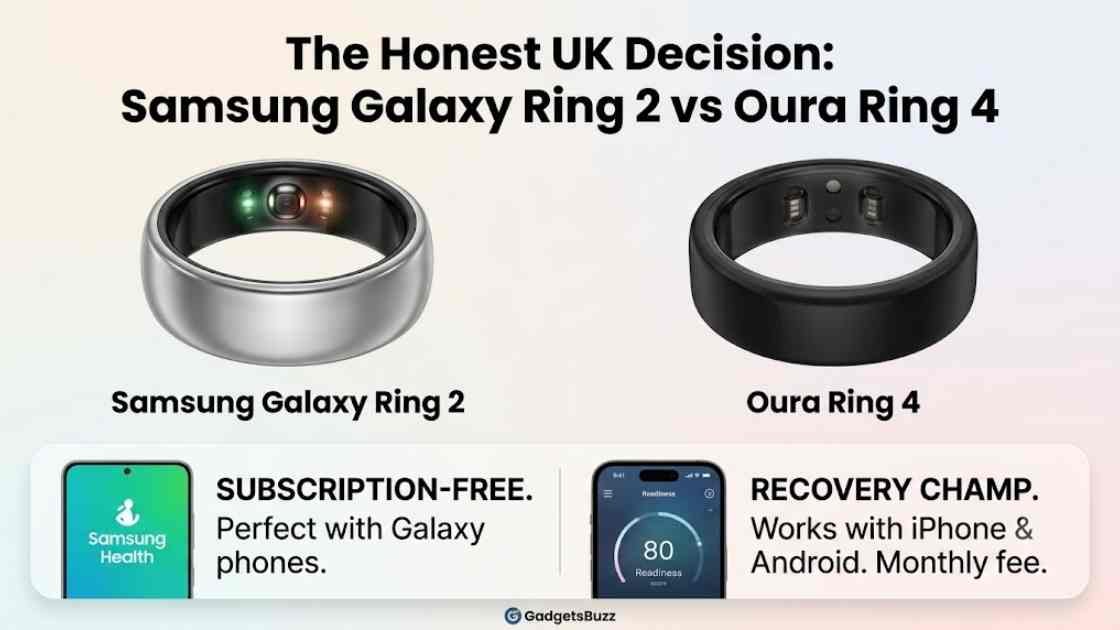
The Samsung Galaxy Ring 2 vs Oura Ring 4 UK decision comes down to one honest question: do you want a subscription-free ring that lives happily inside Samsung’s world, or the most refined sleep and recovery tracking on the market with a monthly fee attached? I have worn both, one on each hand, for six weeks, and the gap between them is smaller than the marketing suggests but matters enormously depending on the phone in your pocket.
As a certified personal trainer who has tested wearables on my own training for years, I care less about glossy spec sheets and more about whether the data holds up when you are tired, sweaty, and trying to decide if you should train or rest. Both of these rings are excellent. Neither is the obvious winner for everyone. Here is how they actually compare for women in the UK in 2026.
Samsung Galaxy Ring 2 vs Oura Ring 4 UK: the short answer
If you own a Samsung Galaxy phone and you hate subscriptions, the Galaxy Ring 2 is the easy pick. Your sleep, heart rate and activity data flow straight into Samsung Health with nothing extra to pay, ever. If you want the deepest, best-explained recovery insights and you do not mind paying monthly, the Oura Ring 4 still sets the standard, and it plays nicely with both iPhone and Android.
That is the headline. The detail is where it gets interesting, because the two rings are built around very different ideas of what a smart ring is for.
Price and the subscription question
This is the first thing to understand, because it changes the real cost more than any single feature.
The Oura Ring 4 costs around £349 for the ring, then roughly £5.99 a month for the Oura membership that unlocks most of the scores and trends. Without the membership the ring becomes close to useless, so budget for it. Over two years that is the ring plus about £144 in fees.
The Galaxy Ring 2 sits at a similar hardware price, around £399, but there is no subscription. Everything you see on day one is yours for the life of the ring. For a two-year horizon, that difference is real money.
I know, a monthly fee for a ring you already bought feels cheeky. Bear with me on this one though, because the Oura membership is not just a paywall. It funds the genuinely clever interpretation work, and that interpretation is the main reason people stay loyal to Oura. Whether it is worth £5.99 a month is a personal call, and I will come back to it.
Samsung Galaxy Ring 2 | Around £399
Accuracy: heart rate, sleep and the data that matters
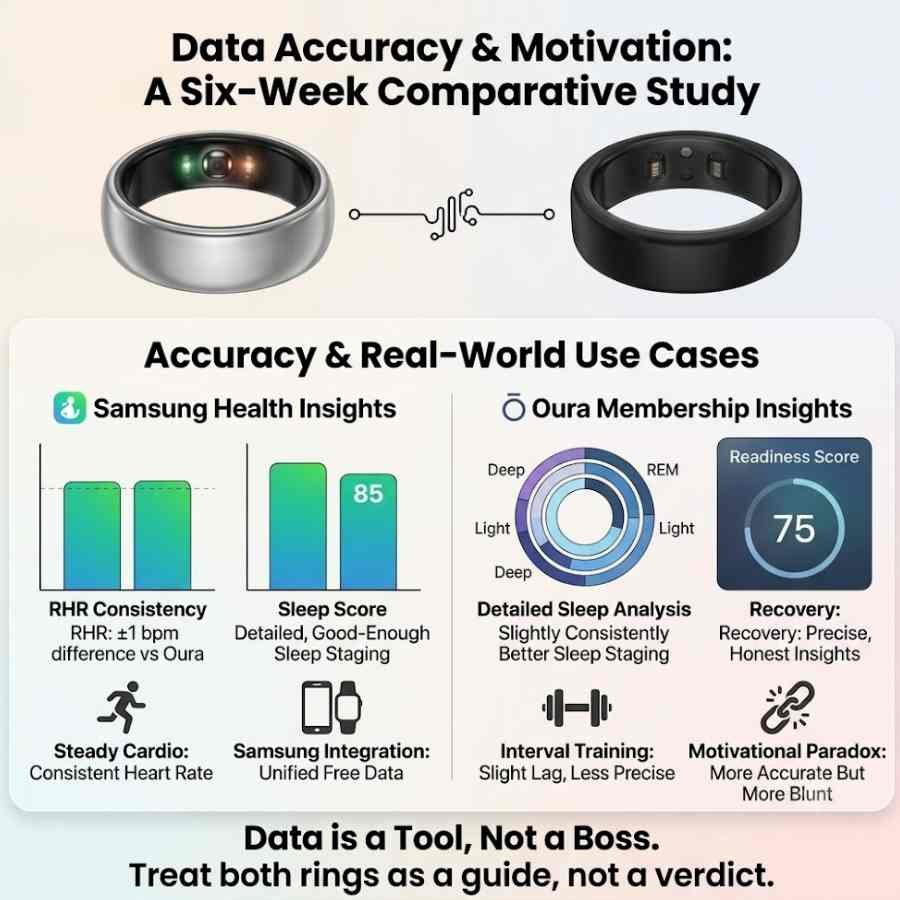
After six weeks of wearing both, the accuracy story is closer than I expected. I compared resting heart rate every single morning, and the two rings landed within one or two beats per minute of each other almost every day. That is reassuring, because resting heart rate is one of the most useful signals for spotting when you are run down or coming down with something.
For sleep staging, Oura still has the edge. Its breakdown of light, deep and REM felt more consistent with how I actually slept, and on the mornings I woke up groggy, the Oura score reflected it more honestly. Samsung has closed the gap a lot, and for most people the Galaxy Ring 2 sleep data is more than good enough, but Oura remains the one I trusted most when the nights were broken.
One honest, slightly counterintuitive observation from my testing: the more accurate ring is not always the more motivating one. On a couple of mornings the Oura readiness score was so blunt about my poor recovery that I almost talked myself out of a session I felt fine to do. Data is a tool, not a boss. Treat both rings as a guide, not a verdict.
For heart rate accuracy during exercise, neither ring is built to replace a chest strap. Smart rings measure from the finger, which moves a lot during weights and high-intensity work, so readings can lag. The NHS notes that wearable heart rate readings are estimates rather than medical measurements, and that holds true here. For steady cardio and all-day trends they are great. For interval precision, use a chest strap.
Battery life and charging
The Galaxy Ring 2 gives you up to about seven days on a charge in real use, and the Oura Ring 4 lands around the same, roughly six to seven days depending on features. In practice I charged both once a week and never thought about it, which is exactly how a ring should behave.
The charging experience differs slightly. Oura uses a small puck-style dock that is easy to live with on a bedside table. Samsung’s case acts as a charger and a carry case in one, which is handy if you travel. Small thing, but if you forget chargers constantly like I do, the Samsung approach saves you.
The app and ecosystem: this is the real decider
Here is where the Samsung Galaxy Ring 2 vs Oura Ring 4 UK choice usually gets settled.
Samsung Health is clean, free, and brilliant if you already use a Galaxy phone and maybe a Galaxy Watch. The ring and watch work together, the data sits in one place, and there is an Energy Score that summarises your readiness without charging you for it. The catch is that the Galaxy Ring 2 is at its best with a Samsung phone. It works with other Android phones, but you lose some polish, and it does not support iPhone in any meaningful way.
Oura is the opposite. It is platform-neutral, so iPhone and Android users get the same experience, and the app is the most thoughtful in the category. The way it explains why your readiness is low, and what to do about it, is still unmatched. For women specifically, Oura’s cycle and temperature insights are more mature, which matters if you are tracking your menstrual cycle alongside sleep and stress.
In my experience, the app is what you actually live with every day, far more than the hardware. So choose the ecosystem first and the ring second.
Design, comfort and sizing
Both rings are light, comfortable and discreet enough to wear to a UK office meeting without anyone clocking that it is a gadget. The Galaxy Ring 2 has a slightly concave finish that resists scratches well, and the Oura Ring 4 moved to a fully recessed sensor design that feels smoother against the finger than older Oura models.
Get the sizing kit from either brand before you commit. Fingers change size with temperature and time of day, and a ring that is even half a size out will give you patchier readings. I wore my sizing samples for a couple of days each before ordering, and it was worth the wait.
Who should buy the Samsung Galaxy Ring 2
Buy the Galaxy Ring 2 if you own a Samsung Galaxy phone, you want zero subscriptions, and you like the idea of your ring and watch sharing one tidy app. It is the better value over two years, the battery and case combo is convenient, and the data is accurate enough for almost everyone. It is the practical, no-nonsense choice for UK women already inside Samsung’s ecosystem.
Who should buy the Oura Ring 4
Buy the Oura Ring 4 if you use an iPhone, or if recovery and sleep insight is the whole reason you want a ring. The interpretation is deeper, the cycle tracking is stronger, and the app simply teaches you more about your own body. You are paying monthly for that intelligence, so go in knowing the running cost, but for many people it is the ring that actually changes their habits.
If you want to see how smart rings stack up against more traditional trackers before you decide, our guide to the Oura Ring Gen 4 vs Evie Ring comparison is a useful next read, and if heart health is your main worry, see which fitness tracker can detect AFib. For better nights, our piece on smart sleep technology pairs well with either ring.
Frequently asked questions
Is the Samsung Galaxy Ring 2 better than the Oura Ring 4?
Neither is universally better. The Galaxy Ring 2 wins on value and Samsung integration with no subscription. The Oura Ring 4 wins on sleep and recovery depth and works equally well with iPhone and Android. Choose based on your phone and whether you want a monthly fee.
Does the Samsung Galaxy Ring 2 work with an iPhone?
Not properly. The Galaxy Ring 2 is designed for Samsung Galaxy phones and is limited on other Android devices, with no real iPhone support. iPhone users should choose the Oura Ring 4.
Do you have to pay a subscription for the Oura Ring 4?
Yes, in practice. Most scores and trends sit behind the Oura membership at around £5.99 a. The Galaxy Ring 2 has no subscription at all.
How accurate are smart rings for heart rate?
Resting and all-day heart rate from both rings is reliable for trends. During intense exercise, finger-based sensors can lag, so use a chest strap for precise interval training. Wearable readings are estimates, not medical measurements.
Which smart ring is best for tracking your menstrual cycle?
The Oura Ring 4 currently has the more mature cycle and temperature tracking, which makes it the stronger choice if cycle insight is a priority for you.
The bottom line
The Samsung Galaxy Ring 2 vs Oura Ring 4 UK contest has no single winner, and that is good news. Match the ring to your phone and your feelings about subscriptions, and either one will serve you well for years. Samsung users who hate fees should take the Galaxy Ring 2. iPhone users and recovery obsessives should take the Oura Ring 4.
Priya Nair is a certified personal trainer who tests wearables through real training for GadgetsBuzz. This article contains affiliate links. We only recommend products we genuinely rate. This is general guidance only. Always consult your GP or a qualified professional for personal advice.