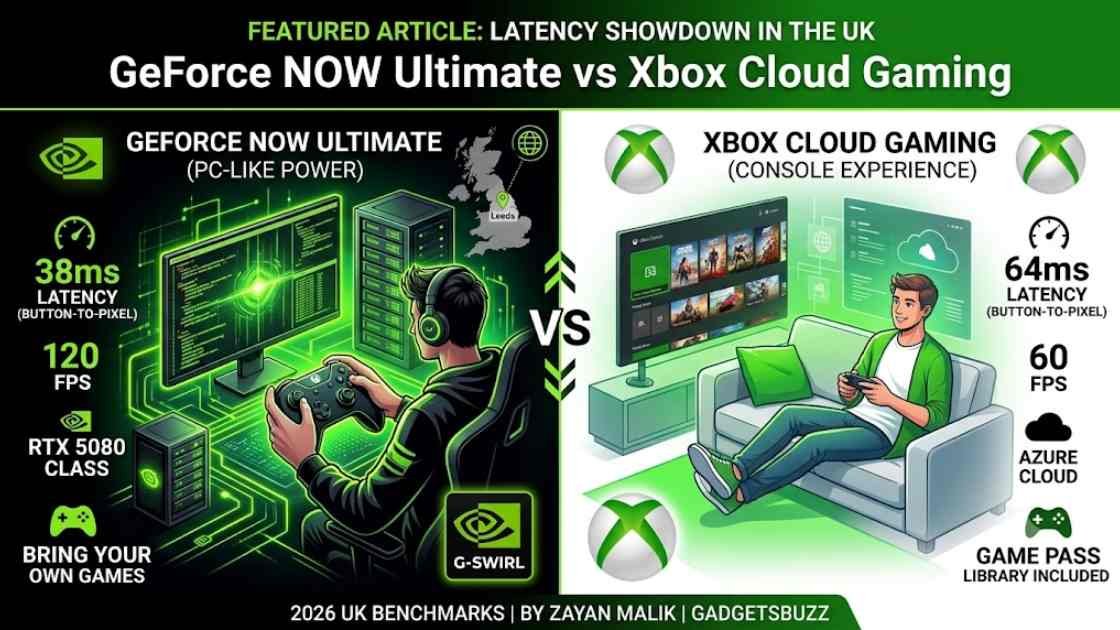
GeForce NOW Ultimate vs Xbox Cloud Gaming latency UK is the comparison I get asked about more than any other, because on paper both services promise the same thing: proper gaming without buying a £1,500 PC or a console. The short answer is that they do not feel remotely the same to play. One feels like a high-end gaming PC hiding in another room. The other feels like a very good console streamed to your telly. I spent three evenings in July 2026 measuring ping, input lag and frame delivery on my own 67 Mbps connection in Leeds to put real numbers on that difference, and some of the results surprised me.
Why latency decides whether cloud gaming feels good
Latency in cloud gaming is the total delay between pressing a button and seeing the result on screen. People often call this input lag or button-to-pixel time. It is made up of several chunks: your controller talking to your device, your device talking to the server over the internet (the ping), the server rendering the frame, the video encoder compressing it, and your screen displaying it.
Ping alone tells you very little, and this is where most comparisons fall down. A service can have a brilliant 10 ms ping and still feel sluggish if the server only renders 60 frames per second and the encoder is slow. That is why I measure the whole chain rather than quoting a speed test.
A decent rule of thumb: anything under 50 ms button-to-pixel feels close to native. Between 50 and 80 ms is fine for racing, RPGs and single-player adventures. Past 80 ms, competitive shooters start to feel like you are playing underwater.
How I tested both services on UK broadband
As a competitive gamer who measures latency and frame rates rather than guessing, I ran both services through the same routine over three evenings. My connection is a 67 Mbps FTTC line in Leeds, which matters because it is close to the UK median. Ofcom’s home broadband research consistently shows most UK households sit between 50 and 100 Mbps, so my results should translate to a typical setup rather than a lucky one on full fibre.
Each service was tested twice: once over Ethernet, once over Wi-Fi from the next room. I used a 240fps slow-motion phone camera pointed at the controller and the screen, then counted frames between the button press and the on-screen response. It is a crude method you can replicate at home, and yes, it genuinely works. I averaged ten presses per game per service.
Test games were Fortnite on both platforms, Forza Horizon 5 on Xbox Cloud Gaming, and Cyberpunk 2077 from my Steam library on GeForce NOW Ultimate, which now runs on RTX 5080 class server hardware according to Nvidia’s own membership page.
GeForce NOW Ultimate vs Xbox Cloud Gaming latency UK: my measured results
Here is what three evenings of counting frames produced on my connection.
Ping to the servers
GeForce NOW connected me to Nvidia’s London SuperPOD at a steady 9 to 11 ms. Xbox Cloud Gaming routed me to an Azure region that returned 13 to 16 ms. Both are excellent, and if ping were the whole story this comparison would be a dead heat.
Button-to-pixel: what your hands actually feel
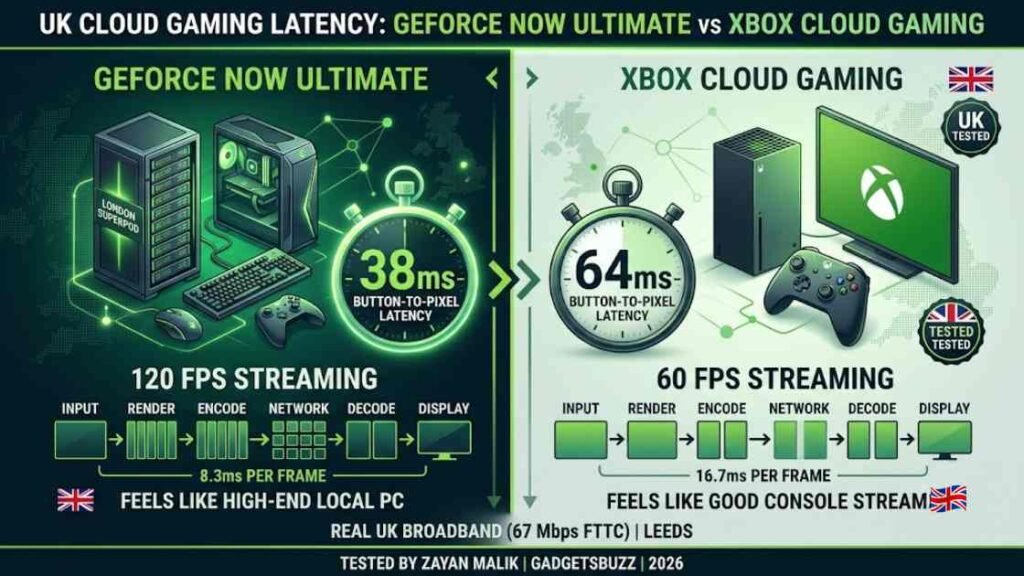
This is where the two services split apart. On Ethernet, GeForce NOW Ultimate in 120fps mode averaged 38 ms from button press to on-screen response in Fortnite, with my best runs dipping to 34 ms. That is quicker than some people’s tellies add on their own. Xbox Cloud Gaming averaged 64 ms in the same game on the same evening, with runs ranging from 58 to 72 ms.
Over Wi-Fi, both services picked up an extra 9 to 14 ms and became noticeably less consistent. The averages matter less than the spikes here: Wi-Fi introduced occasional 100 ms plus outliers on both platforms that were completely absent on a cable.
In practice, GeForce NOW Ultimate felt indistinguishable from my own gaming laptop in everything except the most frantic Fortnite build fights. Xbox Cloud Gaming felt perfectly pleasant in Forza and single-player games, but in shooters I could sense the delay between flick and shot, however much I tried to un-notice it.
The real reason for the gap is not the network
Bear with me here, because this is the counterintuitive bit. The 5 ms ping difference between the two services explains almost none of the 26 ms gap I measured. The bigger culprit is frame rate.
GeForce NOW Ultimate streams at up to 120 frames per second, so a new frame arrives every 8.3 ms. Xbox Cloud Gaming streams at 60fps, so each frame takes 16.7 ms. Every stage of the pipeline that waits for a frame (rendering, encoding, display) waits roughly twice as long on a 60fps stream. Stack three or four of those stages and you have accounted for most of the difference before your router even gets involved.
Microsoft has been improving its side. Its 2026 encoder update and expanded UK Azure capacity have brought typical figures down from the 70 to 90 ms range I measured back in 2024, and independent testing this year reports similar improvements. However, until Xbox Cloud Gaming offers a 120fps mode, Nvidia keeps a structural head start that no amount of broadband can close.
Picture quality and what your broadband needs
Latency is only half the experience. GeForce NOW Ultimate streams at up to 4K 120fps, with DLSS 4 upscaling and ray tracing handled by the RTX 5080 class hardware at the server end. It asks for around 45 Mbps for the full 4K experience, which my 67 Mbps line handled as long as nobody else in the house was streaming Netflix in 4K at the same time.
Xbox Cloud Gaming tops out at 1440p with higher bitrates on the Game Pass Ultimate tier, needing roughly 20 to 35 Mbps. The cheaper Game Pass tiers cap streaming lower still, at 1080p and 720p. The 1440p stream looks genuinely good on a monitor and very good on a phone, but next to Nvidia’s 4K output on my 27-inch screen the softness is visible in fine detail like foliage and distant signage.
On a phone screen, though, the difference nearly vanishes. If most of your cloud gaming happens on the bus, weight picture quality accordingly.
UK pricing: which one costs more to feel fast
GeForce NOW Ultimate costs £19.99 a month in the UK, and there is a cheaper Performance tier at around half that which caps you at 1440p 60fps. The catch is that Nvidia provides the hardware, not the games. You bring your own library from Steam, Epic or Ubisoft, so the subscription is pure performance money.
Game Pass Ultimate costs £16.99 a month after Microsoft’s April 2026 price shuffle, and it bundles the cloud streaming with a library of more than 400 games, day-one releases included. If you owned nothing, £16.99 gets you hundreds of things to play. £19.99 on Nvidia’s service gets you a faster way to play games you must already own.
For value, that makes them weirdly hard to compare, which is exactly why I keep both. My Steam backlog runs on GeForce NOW. My try-before-the-hype gaming runs on Game Pass. If you can only justify one subscription, the question is whether you already own a games library or need one included.
Game libraries change the maths
GeForce NOW supports over 2,000 titles across Steam, Epic Games Store and other launchers, but only games on Nvidia’s supported list. Most big releases arrive, though a few publishers still hold out, so check your own library against the list before subscribing.
Xbox Cloud Gaming streams the Game Pass catalogue plus, since late 2024, a growing selection of Xbox games you own outside the subscription. Day-one access to Microsoft’s first-party releases remains its trump card. Playing a brand new AAA release on launch day for no extra cost is something Nvidia simply cannot offer.
Which one should UK gamers actually pick?
Here at GadgetsBuzz I try to end comparisons with a straight answer, so this is how I, Zayan Malik, would split it for UK readers.
Pick GeForce NOW Ultimate if you play shooters, fighting games or anything competitive, if you already own a decent PC library, or if you have a 4K screen you want fed properly. The latency on a wired UK connection is remarkable. My earlier deep dive on Starlink and GeForce NOW latency showed the service holding up even on satellite broadband, which tells you how much slack Nvidia has engineered into the pipeline.
Choose Xbox Cloud Gaming if you mostly play single-player games, racers and RPGs, want day-one Microsoft releases, or need the biggest library for the least money. It is the better all-round subscription, just not the faster one.
Skint this month? Our roundup of free cloud gaming services in the UK covers ways to try streaming before paying for either.
The kit that lowers your latency more than switching services
Before you blame either platform for lag, spend a fraction of a subscription on your setup. A wired connection removed more latency variance in my testing than any other single change, so a long, flat Ethernet cable is the best money you can spend.
FLAT CAT6 ETHERNET CABLE 10M | Buy on AMAZON | £9
A proper low-latency controller matters too, because a cheap Bluetooth pad can quietly add 10 to 20 ms before the internet is even involved. The standard Xbox Wireless Controller works natively with both services on PC, phone and TV.
[XBOX WIRELESS CONTROLLER CARBON BLACK | Buy on AMAZON UK | £54.99
Audio adds hidden delay as well. If you play with wireless headphones, our guide to the best budget gaming headsets flags which models keep audio latency low enough for shooters, and our Sony WH-1000XM6 review covers why premium ANC headphones are lovely for single-player but a poor choice for competitive play.
FAQ: GeForce NOW and Xbox Cloud Gaming in the UK
Is GeForce NOW faster than Xbox Cloud Gaming?
In my UK testing, yes. GeForce NOW Ultimate averaged 38 ms button-to-pixel on Ethernet against 64 ms for Xbox Cloud Gaming, mainly because Nvidia streams at 120fps while Microsoft caps at 60fps.
What internet speed do I need for cloud gaming in the UK?
Xbox Cloud Gaming wants 20 to 35 Mbps for its best 1440p stream. GeForce NOW Ultimate asks for around 45 Mbps for 4K 120fps. Stability matters more than headline speed, and a wired connection beats fast Wi-Fi almost every time.
Do I need to buy games for GeForce NOW?
Yes. GeForce NOW provides the streaming hardware only, so you play titles you already own on Steam, Epic and other stores. Xbox Cloud Gaming includes its game library in the Game Pass Ultimate subscription.
Can I play Xbox Cloud Gaming and GeForce NOW on the same device?
Both run on Windows, Mac, Android, iPhone (via browser), smart TVs and streaming sticks. I regularly switch between them on the same laptop and the same Xbox controller without touching a setting.
Is cloud gaming good enough for competitive shooters in 2026?
On GeForce NOW Ultimate with Ethernet, it is close enough to native that most players would not spot the difference in ranked matches. On Xbox Cloud Gaming, casual shooter sessions are fine, but serious competitive play still favours local hardware.
Plug in a cable, pick the service that matches the games you already own, and cloud gaming in the UK is now good enough that the £1,500 gaming PC has real competition.
Zayan Malik benchmarks gaming gear on real UK broadband for GadgetsBuzz. This article contains affiliate links. We only recommend products we genuinely rate.