
🚀 The Starlink GeForce NOW Latency Challenge
The rise of Low-Earth Orbit (LEO) satellite constellations, led primarily by SpaceX’s Starlink, has transformed internet accessibility for rural and underserved regions. Unlike traditional Geostationary Orbit (GEO) systems, where signals must travel more than 22,000 miles and often generate latencies above 600 milliseconds (ms), Starlink satellites operate at roughly 550 kilometers. This massive reduction in physical distance enables significantly lower ping times and places Starlink GeForce NOW latency at the center of modern cloud gaming discussions.
As more players test how well Starlink handles GeForce NOW Ultimate, the core question becomes whether its LEO architecture can consistently deliver the smooth and responsive performance that competitive cloud gaming demands.
This performance potential positions Starlink as a serious option for high-demand and latency-sensitive services. GeForce NOW Ultimate delivers near-native PC gaming streamed to almost any supported device, including resolutions up to 5K and frame rates up to 360 FPS. If you want to compare it against other platforms, check out our Best Free Cloud Gaming Services in 2025 in the UK.
Technologies like NVIDIA Reflex help reduce full-system latency. For a platform engineered to minimize the perception of distance, the ISP’s contribution to total latency becomes the most critical constraint. This is why Starlink GeForce NOW latency has become a major point of evaluation.
The core issue extends beyond asking whether Starlink can run GeForce NOW. The more important question is whether Starlink’s latency and stability profile is reliable enough to support the competitive and low-latency environment that GeForce NOW Ultimate is designed to provide. A low average ping is only one part of the performance equation. Consistency of that ping, measured as jitter, along with short bursts of packet loss caused by satellite handovers or brief obstructions, ultimately determines whether reaction-based esports titles can be played without compromise.
This analysis provides a clear technical breakdown of Starlink GeForce NOW latency and evaluates how well the network aligns with the strict demands of modern cloud gaming.
❓ What is Starlink GeForce NOW latency?
Starlink GeForce NOW latency refers to the round-trip time required for player input to travel through the Starlink satellite network to a GeForce NOW server and return as a rendered video frame. In mid-2025, real-world averages range between 25 ms and 35 ms under optimal conditions.
❓ Does Starlink meet GeForce NOW Ultimate requirements?
Yes, Starlink meets NVIDIA’s minimum network requirements for GeForce NOW Ultimate. However, it does not yet match the ultra-stable performance of fiber internet required for professional esports-level competition.
❓ Who is Starlink best suited for in cloud gaming?
Starlink is best suited for rural, casual, and mid-core gamers who lack fiber access but want smooth 1080p and 4K cloud gaming. It is not yet ideal for serious competitive esports players.
📊 The Technical Latency Benchmark: Starlink vs GFN Requirements
To evaluate whether Starlink is suitable for high-performance cloud gaming, it is essential to begin with the operating requirements of GeForce NOW. NVIDIA recommends a network latency of less than 80 milliseconds from the user’s device to the nearest GeForce NOW data center for an acceptable streaming experience. This 80 ms limit represents the maximum allowable network segment within the total end-to-end latency budget.
In practical terms, this means that if the internet connection alone exceeds this threshold, the combined effects of input delay, server-side processing, video encoding, stream delivery, decoding, and display latency will push the experience beyond the threshold of responsiveness required for modern cloud gaming.
✅ Starlink’s LEO Network Has Shown Consistent Improvements
Starlink has steadily improved its latency profile as satellite density increases and ground infrastructure expands. Recent mid-2025 user reports show median round-trip times between 25 ms and 35 ms across the United States. This marks a significant improvement compared to earlier deployment phases. Starlink has also stated that its long-term target is a stable 20 ms median latency.
These results place Starlink GeForce NOW latency well within NVIDIA’s recommended limits for cloud gaming. For comparison, traditional GEO satellite internet routinely exceeds 600 ms, which makes it entirely incompatible with real-time cloud gaming services.
⚡ The End-to-End Latency Chain: Minimizing Total Delay
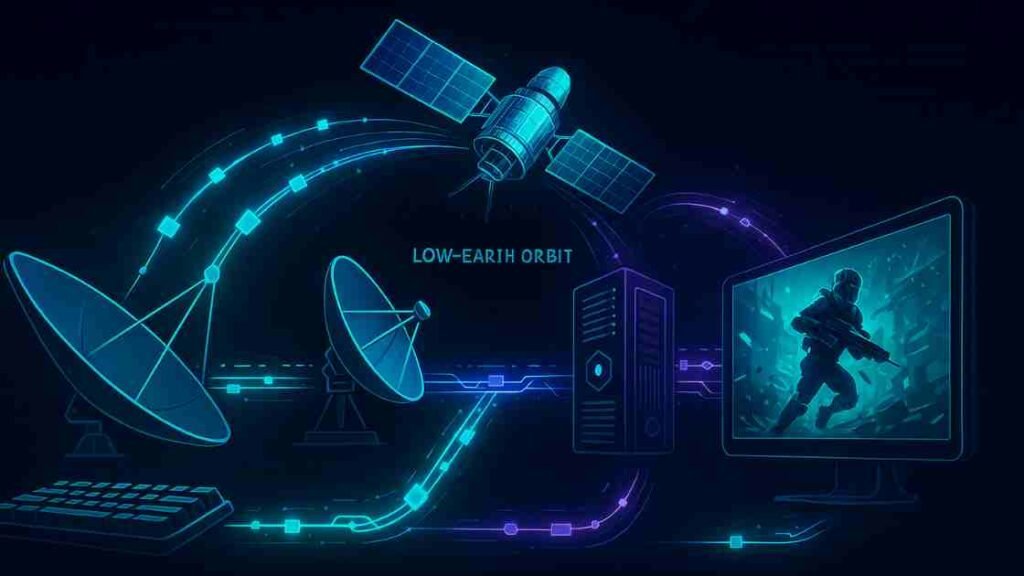
Competitive cloud gaming is essentially a race against time. Every millisecond matters. The goal is to minimize the total delay from a player’s input to the moment that action appears on screen. This complete process consists of four primary latency stages that together define the real-world impact of Starlink GeForce NOW latency.
1. Input Lag (User Device)
This is the time it takes for a controller, keyboard, or mouse input to register and be transmitted to the network. While typically small, low-quality peripherals and wireless connections can introduce measurable delay at this stage.
2. Network Latency (Starlink Component, RTT)
This is where Starlink GeForce NOW latency plays its most direct role. It represents the round-trip time required for the input to reach the GeForce NOW server and for the rendered video frame to return to the user.
Starlink’s median 25 ms to 35 ms RTT is exceptionally strong for satellite internet. However, it is still only one component of a larger latency budget that also includes server processing and client-side decoding.
3. Processing Latency (Server-Side)
Once the input reaches the GeForce NOW data center, the server must process the command, render the scene, encode the video stream, and dispatch it. NVIDIA Reflex significantly reduces this stage by optimizing both server-side and client-side processing overhead.
4. Decoding and Display Latency (Client-Side)
After the video stream is received, the user’s device must decode the incoming frames and display the updated image. Faster GPUs, monitors, and higher refresh rates help minimize this stage, while slower displays can silently add extra delay.
✅ Section Summary: How Starlink Fits into the Full Latency Chain
| Latency Stage | What It Represents | Impact on Starlink GeForce NOW Latency |
|---|---|---|
| Input Lag | Device input delay | Small but unavoidable |
| Network RTT (Starlink) | Satellite round-trip time | Strong at 25 ms to 35 ms |
| Server Processing | Frame rendering and encoding | Reduced by NVIDIA Reflex |
| Client Decoding and Display | Device and monitor delay | Depends on user hardware |
🔎 Key Insight
Starlink performs extremely well on the network transmission side, but overall competitiveness in cloud gaming depends on the combined stability of all four latency stages, not just the average RTT.
🎯 Why This Matters for Competitive Gaming
Even with Starlink’s improved 25–35 ms median RTT, this value represents only one part of the total latency chain. Competitive players — especially in shooters and esports titles — typically aim for full end-to-end latency below 60–70 ms to remain competitive.
Fiber internet users can achieve RTTs as low as 5–15 ms to the nearest GFN server, which gives them a measurable advantage over Starlink users. This does not make Starlink unplayable — it simply means Starlink players begin the latency race a few milliseconds behind.
🧩 Section Summary: End-to-End Latency Chain
| Latency Stage | What It Means | Impact on Starlink GeForce NOW Latency |
|---|---|---|
| Input Lag | Input device delay | Minimal but unavoidable |
| Network RTT (Starlink) | Starlink’s 25–35 ms median | Strong performance; meets GFN requirements |
| Server Processing | Frame rendering + encoding | Reduced by NVIDIA Reflex |
| Client Decoding/Display | Device & monitor delay | Depends on user hardware |
🔎 Key Insight: Starlink performs extremely well on the network side, but full competitiveness depends on eliminating jitter and minimizing spikes — not just reducing average RTT.
🛰️ Starlink’s LEO Advantage: The Physics of Speed and Inter-Satellite Laser Links
Starlink’s ability to achieve median latencies in the 25 ms to 40 ms range is a direct consequence of its Low-Earth Orbit (LEO) architecture. The physics are simple. At an orbital altitude of roughly 550 kilometers, the total ground-to-satellite distance is dramatically shorter than the 35,786 kilometers required for a Geostationary Orbit (GEO) satellite. This massive reduction in signal travel distance is the primary reason why Starlink GeForce NOW latency can remain within competitive cloud gaming thresholds.
Furthermore, the deployment of inter-satellite laser links (ISLs) on newer Starlink satellites marks a critical upgrade for latency performance. In a traditional LEO network without laser links, data must travel from the user terminal up to a satellite and then immediately back down to a ground station before routing through terrestrial fiber to the destination server.
Laser links change this structure completely. They allow the data to jump from one satellite to the next at the speed of light in a vacuum, which is faster than the speed of light in terrestrial fiber optic cable, before descending to the gateway closest to the GeForce NOW data center. This petabit-scale laser mesh enables truly global coverage and, more importantly, a reduced latency path that can bypass long stretches of slower ground fiber. The result is a foundational improvement to the network’s minimum possible latency.
📉 The Jitter and Packet Loss Hurdle: The Enemy of Competitive Play

Despite the impressive average latency metrics, the primary weakness for Starlink GeForce NOW latency in a competitive cloud gaming context remains jitter and packet loss. Jitter refers to the variation in network latency over time. A high jitter rate manifests as momentary lag spikes, stutters, and rubber-banding during gameplay.
Recent mid-2025 data shows significant progress in mitigating this issue. Starlink has reported that fewer than 1 percent of latency measurements exceed 55 ms in the United States. This represents a dramatic improvement in worst-case latency control compared to earlier network performance. While the magnitude of large jumps has been heavily reduced, their complete elimination has not yet been achieved. User reports still mention transient lag spikes lasting a few seconds every 20 to 30 minutes, particularly under demanding conditions.
✅ The Root Causes of Latency Spikes
These temporary spikes are primarily attributed to two structural factors that are inherent to a Low-Earth Orbit satellite network:
1. Satellite Handover
As the Starlink dish maintains a lock on one satellite, it must periodically transfer the connection to the next passing satellite to maintain service continuity. Even brief imperfections during this handoff can introduce a rapid surge in latency or cause partial packet loss. Both of these events are highly disruptive to real-time cloud gaming streams.
2. Obstructions and Weather
The Starlink dish requires a completely clear line of sight to the overhead constellation. Partial obstructions such as trees, buildings, or roof edges can momentarily disrupt the signal. Heavy rain and snow can also interfere with signal stability. These disruptions often result in temporary latency spikes or short service drops.
✅ Why Jitter Matters More Than Average Ping in Esports
A 2 to 4 second lag spike every half hour is negligible for strategy games, casual multiplayer titles, or video streaming. However, in competitive esports titles, where reaction times are measured in milliseconds, even a single brief spike can determine the outcome of a match.
For games designed around the ultra-low-latency environment of GeForce NOW Ultimate, these moments of instability negate the advantage of high frame rates and advanced input optimization. This is why jitter remains the single largest obstacle preventing Starlink from achieving full competitive esports parity with fiber internet.
🎞️ Bandwidth and Fidelity: Can Starlink Reliably Handle 4K and 120 FPS?
While latency dictates responsiveness, bandwidth determines visual fidelity and stream stability. GeForce NOW Ultimate supports high-end streaming modes, including 4K resolution at 120 FPS and 1080p at 360 FPS. These modes require a sustained data rate between 45 Mbps and 65 Mbps, with peak usage approaching 100 Mbps for cinematic-quality streaming.
This makes bandwidth a second critical pillar in evaluating Starlink GeForce NOW latency and overall cloud gaming performance.
✅ Starlink’s High-Bandwidth Capability (Mid-2025 Data)
Starlink’s current median download speeds have risen substantially. According to mid-2025 reports, users in the United States are experiencing median download speeds between 100 Mbps and 200 Mbps. Starlink’s internal data also suggests a median peak-hour downlink near 200 Mbps.
This performance level confirms that Starlink can consistently meet and exceed the raw bandwidth requirements for the highest-tier GeForce NOW Ultimate streams, including 4K at 120 FPS.
✅ The Stability Limitation During Peak Congestion
Despite its high peak speeds, Starlink operates as a best-effort oversubscribed network. Bandwidth stability remains highly sensitive to local cell congestion, particularly during peak usage hours between 7 PM and 10 PM.
During periods of heavy network load, available throughput can drop temporarily. When this occurs, the GeForce NOW stream may reduce its bitrate automatically to maintain continuity. This results in a temporary reduction in resolution or frame rate rather than a full disconnection.
This means that while fiber delivers consistently guaranteed high bandwidth, Starlink’s ability to deliver sustained 4K and 120 FPS gaming remains variable depending on time of day and local network demand.
🎮 Real-World Performance and User Experience: The Starlink Gaming Sweet Spot
User testimonials and long-term testing consistently show that Starlink has made cloud gaming viable in regions where it was previously impossible. For users in rural and underserved areas who previously relied on high-latency GEO satellite connections or slow DSL, Starlink represents a major generational upgrade.
In practical terms, Starlink GeForce NOW latency now falls well within a playable range for most gaming genres, provided that users accept occasional short stability fluctuations.
✅ The Playable Benchmark: 1080p at 60 FPS
Many users report a consistently smooth experience at 1080p resolution and 60 FPS on GeForce NOW when using Starlink, especially when paired with a stable setup and good audio gear. If you are building a budget-friendly gaming setup, our guide to the Best Budget Gaming Headsets 2025 is a great next step.
This remains the optimal performance balance, where the lower bandwidth demand reduces network strain and the latency profile stays stable enough for most gaming sessions.
At this level, genres such as:
- RPGs
- MMOs
- Action adventure games
- Casual multiplayer titles
Perform without meaningful disruption. The current 25 ms to 35 ms median Starlink GeForce NOW latency supports this use case very effectively.
Even some fitness and motion-based titles can work well when latency stays stable. If you enjoy active gaming, see Which Fitness Boxing Game Is Best in 2025? for a full breakdown of the top options.
✅ The Competitive Hurdle: 4K and 360 FPS Esports
Fast-paced esports titles such as:
- Valorant
- Call of Duty
- Apex Legends
remain the most challenging use case for Starlink cloud gaming. While the average latency is now highly competitive at around 30 ms, the connection can still experience brief and unpredictable lag spikes caused by satellite handovers or minor obstructions.
Several users report brief disconnections lasting between 2 and 5 seconds. While these are infrequent, even a single short interruption can completely determine the outcome of a competitive match. This is why Starlink GeForce NOW latency remains highly playable but not fully reliable for professional esports-level competition.
💻 Mitigation and Optimization Strategies for Starlink GFN Performance
For Starlink users looking to minimize latency and maximize their GeForce NOW Ultimate experience, several optimization strategies can mitigate the network’s inherent instability:
- Avoid Peak Hours: Network congestion during peak usage times (typically evenings) can increase both latency and jitter. Gaming outside of these high-traffic periods will often yield a more stable and lower-latency connection.
- Prioritize a Wired Connection (Ethernet): Always connect the client device (PC, NVIDIA Shield, etc.) directly to the Starlink router via an Ethernet cable. This eliminates the highly variable latency and jitter introduced by Wi-Fi, which is critical for cloud gaming.
- Optimal Dish Placement: The single most important factor is ensuring the Starlink dish has zero obstructions and a clear line of sight. Even a small tree branch can cause frequent, brief service drops and latency spikes. Use the Starlink app’s obstruction checker religiously.
- Manual Server Selection: Instead of allowing GeForce NOW to auto-select a server, manually choose the data center closest to your physical location. This minimizes the terrestrial fiber portion of the connection and thus reduces the overall RTT.
- Bypass Router/QoS (Advanced): For experienced users, bypassing the standard Starlink router and using a high-quality personal router with Quality of Service (QoS) features can help prioritize gaming traffic and minimize bufferbloat, further stabilizing the connection.
🏆 Starlink vs Terrestrial Fiber for GeForce NOW (Mid-2025 Update)
The table below provides a concise technical comparison of Starlink GeForce NOW latency versus the performance standard delivered by ideal terrestrial fiber connections. This clearly highlights where Starlink excels and where it still lags behind competitive fiber for cloud gaming.
| Metric | Starlink (LEO Satellite) | Terrestrial Fiber (Ideal Standard) | Impact on GeForce NOW Ultimate |
|---|---|---|---|
| Median Network Latency (RTT) | 25 ms to 35 ms | 5 ms to 15 ms | Starlink is playable, but fiber maintains a competitive edge |
| Worst-Case Latency and Jitter | Fewer than 1 percent exceed 55 ms | Typically under 2 ms | Starlink stability is vastly improved but not yet perfectly stable |
| Median Download Bandwidth | 100 Mbps to 200 Mbps (variable) | 500 Mbps or higher (highly stable) | Starlink easily meets bandwidth needs |
| Streaming Consistency | Variable during congestion | Consistently stable | Fiber delivers uninterrupted esports performance |
| GFN Ultimate Viability | High-quality and mid-core gaming | Optimal for competitive esports | Starlink is a strong alternative but not a competitive equal |
✅ Key Comparison Insight
Starlink now delivers cloud-gaming-class latency and bandwidth, which places it far ahead of all previous satellite internet systems. However, terrestrial fiber remains unmatched for competitive stability, ultra-low jitter, and professional esports performance. For most non-esports gamers, Starlink performs extremely well. For high-stakes competitive gaming, fiber still holds a technical advantage.
Cloud gaming with Starlink is ideal if you want high-end visuals without investing in a powerful PC. On the other hand, if you still prefer owning a local gaming machine, our guide 7 Smart Strategies for Buying Gaming Laptops walks you through choosing the right specs, thermals, and GPU for your budget.
The Future Trajectory of LEO Gaming
The long-term performance trajectory for Starlink remains strongly positive. Continued deployment of new Low-Earth Orbit satellites, expansion of ground stations, and the full-scale rollout of inter-satellite laser links are all designed to further reduce latency and stabilize network performance for cloud gaming. As the constellation becomes denser, each Starlink user terminal will maintain visibility to more satellites at the same time. This will smooth satellite handovers, reduce short latency spikes, and significantly improve overall connection consistency. These upgrades directly strengthen the long-term outlook for Starlink GeForce NOW latency and its competitive gaming viability.
Starlink has publicly stated that its long-term goal is to achieve consistent median latency in the 20 ms to 40 ms range across global regions. If this target is reached with improved stability, the performance gap between satellite and terrestrial fiber will continue to narrow. With expanding laser link coverage reducing reliance on ground-based routing, rural users can expect increasingly fiber-like responsiveness over time. This positions Starlink as a long-term foundation for next-generation cloud gaming rather than a temporary connectivity solution.
And for gamers, creators, or students who still want a powerful local machine alongside cloud gaming, our Best Asus Laptop 2025 for Every User – Student, Creator, Gamer, Business guide covers some of the most balanced performance laptops available right now.
Is Starlink GeForce NOW Latency Good Enough in 2025?
In summary, the technical analysis confirms that Starlink GeForce NOW latency is fully viable for casual and mid-core cloud gaming. With real-world median latency now sitting in the 25 ms to 35 ms range, Starlink comfortably clears NVIDIA’s recommended 80 ms threshold for GeForce NOW Ultimate. This represents a major technological leap for satellite internet and makes high-quality cloud gaming possible in rural and underserved regions where fiber access does not exist. For most gaming genres and everyday play, Starlink delivers a smooth and highly enjoyable experience.
However, competitive esports-level performance remains conditional. While average latency is now impressive, the presence of occasional jitter and brief latency spikes caused by satellite handovers and environmental obstructions continues to limit full competitive reliability. For professional esports players who demand ultra-stable, single-digit millisecond consistency, terrestrial fiber remains the undisputed standard. Starlink should be viewed as a powerful and transformative alternative rather than a direct replacement for fiber in high-stakes competitive gaming scenarios.
Starlink GeForce NOW latency is excellent for casual and mid-core cloud gaming but remains slightly inconsistent for professional competitive esports.
Cloud gaming marathons also depend on physical comfort and posture. If you are using a racing-style chair at your desk, our deep dive on Are Gaming Chairs Good for Office Work? breaks down when they actually help and when they hurt long-term comfort.
Frequently Asked Questions (FAQs)
1. What is the average network latency I can expect from Starlink for cloud gaming?
The current, factual data shows that Starlink users in the U.S. can expect a median network latency (ping) between approximately 30ms and 50ms. This is a vast improvement over previous satellite internet, whose latency exceeded 600ms due to the distance to geostationary orbit. While this average is low enough to be “playable” for GeForce NOW, it is the stability of this connection, known as jitter, that is the more important variable for a smooth gaming session. Continued satellite deployments are expected to push this average even lower and improve consistency over time.
2. Does Starlink meet the minimum requirements for GeForce NOW Ultimate?
Yes, Starlink’s performance generally meets and exceeds the minimum technical requirements set by NVIDIA for GeForce NOW. NVIDIA recommends a network latency of less than 80ms and a bandwidth of 45 Mbps to 65 Mbps for higher-end streams. Starlink’s median latency of 30ms-50ms and median download speed of around 100 Mbps successfully clear these technical benchmarks, making the service fully viable for a high-quality streaming experience. However, achieving the highest-end, competitive 360 FPS mode reliably will still be challenged by moments of network instability.
3. What is ‘jitter,’ and why is it a problem for competitive Starlink cloud gaming?
Jitter refers to the variation or fluctuation in network latency over time, and it is the primary technical hurdle for competitive gaming on Starlink. Even if the average ping is low, a high jitter rate manifests as sudden, momentary lag spikes, stutters, or “rubber-banding” in a game. These spikes occur mainly during satellite handovers or due to minor dish obstructions, briefly causing the latency to surge by 10ms to hundreds of milliseconds, which is catastrophic for time-sensitive, competitive titles where a few milliseconds decide the outcome of an engagement.
4. Is 4K/120 FPS streaming on GeForce NOW Ultimate reliably possible with Starlink?
While Starlink’s median download speeds of approximately 100 Mbps are theoretically sufficient to handle the required 45 Mbps to 65 Mbps for 4K/120 FPS streams, the experience is not reliably *consistent*. The high bandwidth demand makes the stream more susceptible to drops in quality or resolution during periods of network congestion or when the connection experiences even a momentary fluctuation. Casual play at 4K may be successful during off-peak hours, but competitive stability for 4K/120 FPS is still best reserved for rock-solid fiber connections.
5. How does Starlink’s LEO system achieve lower latency than traditional satellite internet?
Starlink achieves its low latency because its satellites operate in a Low-Earth Orbit (LEO) at an altitude of about 550 kilometers, compared to the 35,786 kilometers of Geostationary Orbit (GEO) satellites. This vastly reduced physical distance for the signal to travel is the single greatest contributor to lowering the Round-Trip Time (RTT). Additionally, the deployment of inter-satellite laser links allows data to travel between satellites faster than through ground fiber, creating a more efficient and lower-latency path to the nearest ground station and cloud server.
6. What can a Starlink user do to reduce latency for GeForce NOW?
The most effective steps a Starlink user can take to minimize input lag and latency are to eliminate variable factors on their end. A hardwired Ethernet connection from the client device to the Starlink router is essential, as Wi-Fi introduces unacceptable jitter. Furthermore, meticulous placement of the Starlink dish to ensure zero line-of-sight obstructions is paramount, as even small blockages can cause frequent packet loss and corresponding lag spikes. Finally, manually selecting the closest GeForce NOW data center server can optimize the routing path.
References:
Ookla (2025) – Starlink U.S. Performance Update: Speed, Latency, and Network Growth
https://www.ookla.com/articles/starlink-us-performance-2025
Dishy Central (2025) – Starlink for Gaming: Latency, Stability, and Real-World Performance Review
https://dishycentral.com/starlink-for-gaming
ThousandEyes (2025) – LEO vs GEO Satellite Internet: Why Low-Earth Orbit Delivers Lower Latency
https://www.thousandeyes.com/blog/leo-internet-performance
NVIDIA (Official) – GeForce NOW Ultimate: System and Network Requirements
https://www.nvidia.com/en-us/geforce-now/system-reqs/