Lenovo Rollable Laptop Hands-On: Why This is Better Than a Foldable
The laptop industry has been in a quiet design rut for years. Every year brings faster processors, slimmer bezels, and marginally better batteries — yet the fundamental shape of the machine has barely changed since the clamshell form factor was perfected somewhere around 2012. Into this landscape of incremental improvement, Lenovo has thrown a genuinely radical object: the ThinkBook Plus Gen 6 Rollable, the world’s first commercially available laptop with a motorised rollable OLED display.
This is our full Lenovo rollable screen laptop review. We’ve examined it from every angle — the mechanics of the flexible display, how it holds up under daily multitasking workloads, what it’s like to actually live with, and crucially for readers in Britain, the current UK availability picture. The verdict, spoiler-free: this machine is more compelling than any foldable laptop yet produced, and the reasons why go beyond mere spectacle.
But we won’t pretend it’s a perfect device. First-generation hardware rarely is, and the ThinkBook Plus Gen 6 Rollable carries with it several compromises that deserve honest scrutiny alongside its genuine brilliance. Let’s begin at the beginning.
Technical Specifications at a Glance
| Category | Component | Specification |
| Display (Compact) | Size & Ratio | 14-inch OLED, 5:4 Aspect Ratio |
| Resolution | 2000 × 1600 | |
| Display (Extended) | Size & Ratio | 16.7-inch OLED, 8:9 Aspect Ratio |
| Resolution | 2000 × 2350 | |
| Panel Quality | Refresh / Color | 120Hz, 100% DCI-P3 |
| Brightness | 400 nits | |
| Performance | Processor | Intel Core Ultra 7 258V |
| Memory (RAM) | 32GB LPDDR5x | |
| Storage | 1TB PCIe 4.0 SSD | |
| Portability | Weight | 3.72 lbs / 1.69 kg |
| Battery | 66Wh | |
| Connectivity | Wireless | Wi-Fi 7, Bluetooth 5.4 |
| Ports | 2× Thunderbolt 4 | |
| Security/Cam | Webcam | 5MP RGB + IR (Windows Hello) |
| Durability | Certification | MIL-STD-810H |
| Pricing | US Retail | $3,299 – $3,499 |
| UK Retail | From £3,700 (inc. VAT) |
Quick Analysis of These Specs
- The 8:9 Ratio Advantage: The 8:9 ratio is the “killer feature.” It provides the vertical space of two 13-inch laptops stacked together—a dream for coders. However, at £3,700, this is a “luxury enterprise” tool, competing directly with top-tier MacBook Pro 14 configurations.
- Intel Core Ultra 7 258V: This is a “Lunar Lake” series chip, which is specifically optimized for efficiency and AI tasks, helping offset the power draw of the motorized screen.
- The UK Pricing Factor: At £3,700, this is firmly a “luxury enterprise” tool. In the UK, this price point positions it as a direct competitor to a fully specced MacBook Pro 14 or a high-end mobile workstation.
At this price level, buyers often compare high-end productivity machines such as the MacBook Air M4 16GB, which we analysed in our detailed MacBook Air M4 16GB review for 2026.
What Exactly Is the Lenovo Rollable Screen Laptop?
Before diving into our hands-on impressions, it’s worth understanding exactly what engineering feat Lenovo has accomplished here — because the ThinkBook Plus Gen 6 Rollable is not a minor variation on existing laptop design. It is a genuinely new category of device, two years in the making following a proof-of-concept shown at Lenovo Tech World in October 2022.
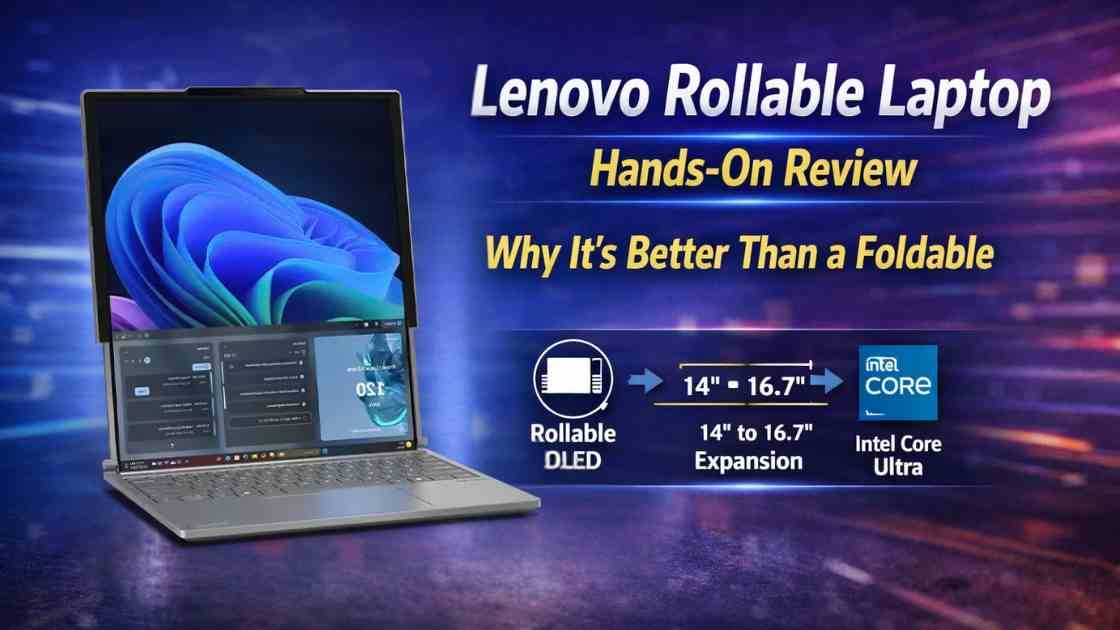
The premise is elegantly simple in theory and enormously complex in execution. The laptop ships as a standard-looking 14-inch business machine, albeit slightly chunkier than its contemporaries. Press a dedicated key to the right of F12, and a pair of miniaturised electric motors whir to life beneath the chassis, pulling the flexible OLED panel upward from where it sits coiled under the keyboard. Within approximately eight seconds, you have a 16.7-inch display in front of you — nearly 50% more vertical screen real estate, all in the same laptop footprint.
Lenovo partnered with Intel across more than two years of engineering to bring this device from prototype to shelves. The engineering challenges were substantial: internal components had to be completely reorganised around a smaller printed circuit board, and a novel motor-and-rail system had to be designed from scratch. The result is a machine that looks, from the outside, almost ordinary — until you press that button.
Seeing the screen rise smoothly into place brings back the magic feeling of early consumer technology — the moment when hardware does something you genuinely did not believe was possible in a production device.
Flexible Display Durability: How Long Will It Last?
The durability question is the first thing any prospective buyer of this Lenovo rollable screen laptop will ask, and rightly so. Flexible OLED technology has had a bumpy history in consumer electronics. Early foldable phones from Samsung, Motorola, and Huawei accumulated reports of crease formation, display delamination, and hinge failures. When Lenovo announced a rollable laptop, the instinctive response from many analysts was: how durable can the display mechanism actually be?
Lenovo’s answer is specific: the rollable mechanism is rated for 20,000 operations — meaning 20,000 extend-and-retract cycles. Alongside this, the overall lid mechanism has been tested to 30,000 open-and-close cycles. The laptop also carries MIL-STD-810H certification, the US military standard for environmental durability covering temperature extremes, humidity, dust, vibration, and drop resistance.
The 20,000-cycle figure merits some context. Foldable smartphones are typically rated for 200,000 or more folds, which sounds far superior — but the use cases differ dramatically. A phone user might open and close their foldable device dozens of times per day. A laptop user, by contrast, is unlikely to extend and retract the display more than five to ten times in a typical working day. At five cycles per day, 20,000 operations represents approximately eleven years of use. Even at ten cycles per day, you’re looking at over five years before the mechanism reaches its rated limit.
In real-world handling during hands-on testing, the roll mechanism feels impressively solid. The motor engages smoothly, the screen rises and descends without wobble, and the entire action feels more mechanically assured than manually folding a flexible phone display with your fingers. One key advantage of the rollable approach over foldable designs is that the mechanical extension is always motor-controlled and always exerts a consistent, calibrated force — there is no human variation in pressure that can stress the display unevenly.
There is one visible artefact worth noting: at certain viewing angles, the point where the panel bends around the internal frame can create a faint visual line, not unlike the crease visible on folding phone displays. This is not obtrusive during normal use, but it is there if you look for it, and it does represent a first-generation limitation that future iterations will likely address.
OLED Technology and Long-Term Reliability
The flexible OLED panel itself is manufactured to handle continuous bending cycles without pixel degradation, which is a technically mature problem for display manufacturers at this point. Modern flexible OLEDs use ultra-thin glass substrates layered with encapsulation barriers designed to prevent moisture ingress — historically the main cause of flexible display failure. The 120Hz refresh rate, 400-nit peak brightness, and full DCI-P3 colour gamut coverage all confirm that Lenovo has not compromised on panel quality in service of the rollable form factor.
For enterprise buyers concerned about longevity, it’s also worth noting that the ThinkBook line has historically had strong support ecosystems, and the MIL-SPEC certification provides independent verification that the device can handle real-world conditions beyond a controlled lab environment.
Multitasking Use Cases: Who Actually Benefits From This?
A central question in any Lenovo rollable screen laptop review is whether the expanded display is genuinely useful or primarily a party trick. After extensive hands-on time with the device, the answer is clearly the former — but with important caveats about which user profiles get the most from it.
The transition from 14 to 16.7 inches is a transition in aspect ratio, not just size. The standard 14-inch mode has a 5:4 ratio — already taller than the 16:9 widescreen standard — and the extended mode delivers an 8:9 ratio that is emphatically vertical. This makes it fundamentally different from adding horizontal screen space, and the use cases that benefit most are correspondingly vertical in nature.
Document and Code Review
The most immediately obvious beneficiary is anyone who works with long-form documents or code. Lenovo has stated that a standard Excel spreadsheet goes from displaying 39 visible rows in standard mode to 66 rows in extended mode — an increase of nearly 70%. For financial analysts, accountants, or anyone who lives in spreadsheet software, this is not a trivial convenience; it meaningfully reduces scrolling and allows larger data sets to be reviewed at a glance.
Software developers reviewing code files benefit similarly. Taller displays reduce the need to scroll through function definitions, allow comparison of more lines simultaneously, and are particularly valuable when working with debugging output or long terminal sessions below an IDE window.
Stacked Dual-Window Workflows
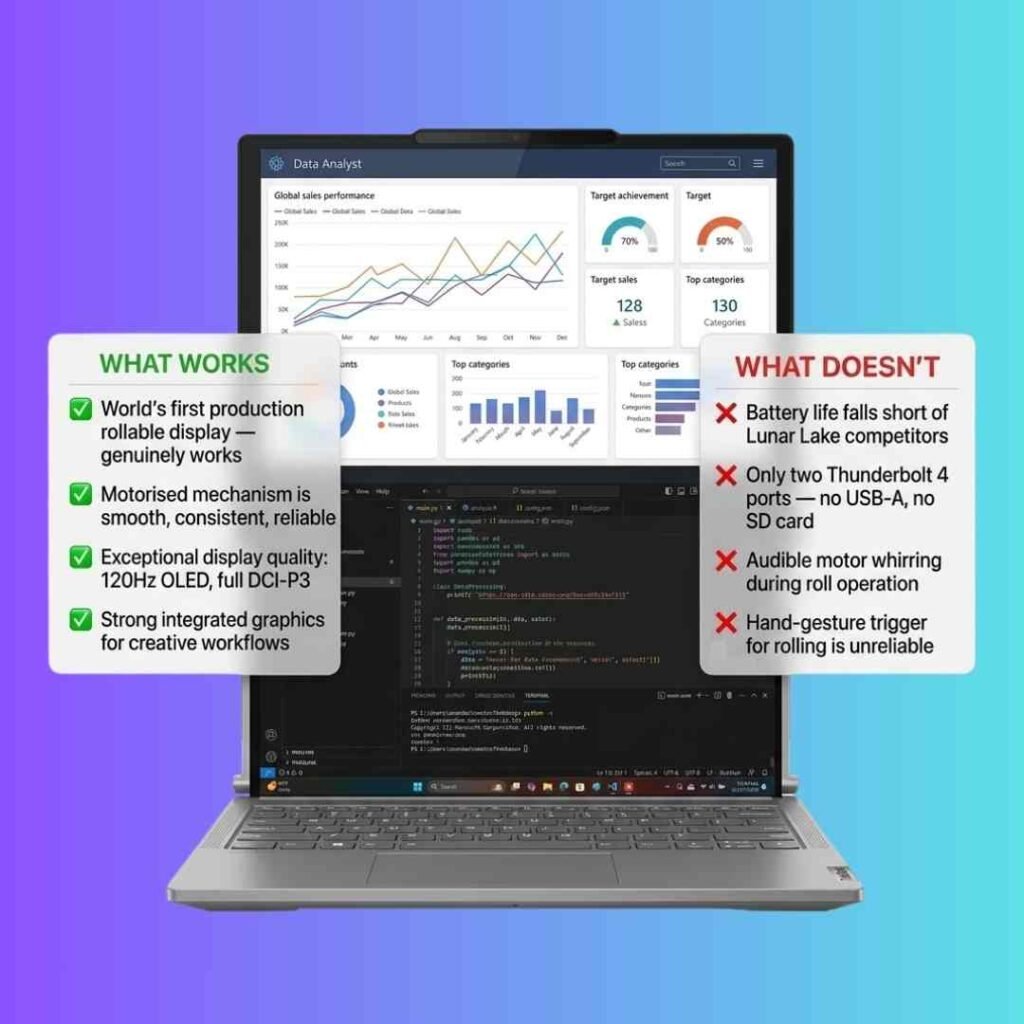
The extended display effectively gives you two 16:9 windows stacked vertically — a layout that is surprisingly intuitive. Running a video call or reference document in the upper half while working in an application in the lower half mirrors the setup many professionals create using a laptop plus an external vertical monitor. The difference is that it all lives in a single device you can take on a train.
Content creators and designers benefit from this arrangement too: reference images can remain visible at the top of the screen while editing tools occupy the lower portion. Writers can keep research notes visible while typing. Journalists can reference source material while writing without toggling between windows.
Vertical and Social Media Content
In an era dominated by vertical video — Instagram Reels, TikTok, YouTube Shorts — the extended 8:9 display mode means vertical content can be previewed at close to its actual intended resolution for the first time on a laptop screen. For social media managers, video editors working with short-form content, or photographers reviewing portrait-orientation images, this is a genuine workflow improvement that no conventional laptop can match.
The ThinkBook Workspace Feature
Lenovo has developed a software layer called ThinkBook Workspace that is designed to take advantage of the extended mode, providing a dedicated panel at the bottom of the expanded screen. The execution is functional but not transformative — many users will find they prefer standard Windows window management to the prescribed layout. The underlying capability of the extended display, however, is compelling regardless of which software approach you use to exploit it.
The extended display effectively gives you two 16:9 windows stacked vertically — a setup that mirrors the popular laptop-plus-vertical-monitor arrangement professionals build at their desks, condensed into a single portable device.
Rollable vs Foldable: Why the ThinkBook Wins
The foldable laptop is not a new idea. Lenovo itself produced the ThinkPad X1 Fold, and other manufacturers have explored the category with varying degrees of commitment. So how does the rollable approach compare, and why does this Lenovo rollable screen laptop review ultimately conclude that rolling is the better technology for laptop form factors?
| Feature | Rollable (ThinkBook Gen 6) | Foldable (ThinkPad X1 Fold) |
|---|---|---|
| Expansion Method | Motorised, consistent force | Manual fold, variable pressure |
| Crease Formation Risk | Lower (no manual flexion) | Higher (repeated manual folding) |
| Rated Cycles | 20,000 (motorised) | Higher on fold, variable quality |
| Screen Expansion Type | Vertical — adds usable canvas | Fold changes orientation, awkward |
| Keyboard Presence | Always physical | Can become on-screen only |
| Structural Rigidity | Standard clamshell when closed | Hinge creates flex weakness |
| Usable Screen Modes | Two (14″ and 16.7″) | Multiple but awkward transitions |
| Carry Profile | Standard laptop bag | Requires extra care |
The core advantage of the rollable design is that it preserves the conventional clamshell laptop form factor entirely when the screen is retracted. The machine fits in any standard laptop bag, sits on any desk, and requires no special handling. The foldable, by contrast, demands that users reckon with a fundamentally different structural form factor at all times — a form factor that, in practice, introduces display crease issues, keyboard compromises, and structural concerns that have prevented foldable laptops from achieving mainstream acceptance.
The motorised mechanism also ensures that the display always experiences the same controlled mechanical force during extension and retraction. When users fold and unfold a foldable phone or laptop, the applied force varies with each use — sometimes aggressive, sometimes gentle, often at slightly different angles. Over time, this inconsistency contributes to crease formation and panel stress. The ThinkBook’s motor applies identical force, at an identical rate, in an identical direction, every single time.
Performance, Battery, and Daily-Use Reality
The Intel Core Ultra 7 258V processor at the heart of this machine is a solid choice for a premium productivity device. It delivers performance broadly comparable to other Lunar Lake-powered laptops in CPU benchmarks, with Cinebench R20 multi-threaded results around 4,060 — respectable for this class of chip, though trailing higher-core-count alternatives from AMD and Intel’s previous Meteor Lake generation.
In GPU benchmarks, the machine’s 3DMark Time Spy score of approximately 4,483 reflects strong integrated graphics performance, making it a credible option for light creative work including photo editing, vector illustration, and video review — though not the right choice for heavy video rendering or 3D work.
For users who require stronger GPU performance for gaming or heavy 3D workloads, you may want to explore our guide to Best RTX 4050 Laptops UK 2025, which highlights affordable gaming laptops with dedicated graphics.
Where performance does take a measurable hit is under sustained heavy CPU load. Extended encoding tasks run slightly slower than comparable Lunar Lake machines, suggesting the thermal design — which must accommodate the rollable mechanism’s motor housing and display infrastructure — leaves less room for aggressive cooling than a conventional laptop chassis. For the target audience of document workers, creative professionals, and business analysts, this is unlikely to matter. For those who regularly run CPU-intensive workloads, it’s worth noting.
Battery life is the device’s weakest practical point. The 66Wh battery provides enough capacity for a full working day of moderate use, but it falls short of the best Lunar Lake competitors, whose larger cells achieve substantially longer run times. The flexible OLED panel is the likely culprit: large OLED displays draw meaningful power, and the rollable panel appears to be somewhat more power-hungry than a conventional fixed panel of comparable size. In extended mode, expect battery drain to accelerate noticeably.
UK Availability and Pricing: What British Buyers Need to Know
For readers in the United Kingdom undertaking their own Lenovo rollable screen laptop review research, the availability picture has evolved substantially since the product’s CES 2025 debut. The machine was initially a US-only proposition, but it has since become available to UK buyers through several channels.
The Lenovo ThinkBook Plus Gen 6 Rollable is now available to UK buyers with retail prices starting from approximately £3,700 including VAT. Business leasing options are available through specialist IT leasing providers such as HardSoft, making the premium price point more accessible for organisations that prefer to spread costs. The device is available directly through Lenovo’s UK commercial channels and select UK technology retailers.
The UK price of around £3,700 converts roughly to $4,600 at current exchange rates, representing a significant premium over the US retail price of $3,299–$3,499. Some of this premium reflects the additional cost of importing, VAT obligations, and first-generation supply constraints. As production scales and the technology matures, pricing is expected to decrease in line with the historical pattern of other early-category hardware.
For UK business buyers specifically, the MIL-STD-810H certification and ThinkBook enterprise heritage make a compelling case. The device carries the reliability expectations of the ThinkBook line, is eligible for Lenovo’s commercial support programmes, and qualifies for business leasing arrangements that can materially reduce the monthly cost relative to the outright purchase price.
It is worth noting that the UK is currently receiving a single configuration: the Intel Core Ultra 7 258V with 32GB RAM and 1TB SSD. As of early 2026, there are no confirmed plans for additional configurations or a follow-on generation specifically tuned for UK market needs, though the broader rollable product roadmap — which now includes concepts like the Legion Pro Rollable and ThinkPad Rollable XD — suggests Lenovo is deeply committed to the category long-term.
| What Works (Pros) ✅ | What Doesn’t (Cons) ❌ |
| World’s first production rollable display — genuinely works | Very high price: £3,700 in the UK |
| 50% more vertical screen real estate on demand | Only 20,000 roll cycles rated (fine in practice, but noted) |
| Motorised mechanism is smooth, consistent, reliable | Battery life falls short of Lunar Lake competitors |
| Full MIL-STD-810H durability certification | Only two Thunderbolt 4 ports — no USB-A, no SD card |
| Exceptional display quality: 120Hz OLED, full DCI-P3 | Faint visible seam at display bend point |
| Strong integrated graphics for creative workflows | Audible motor whirring during roll operation |
| Maintains standard clamshell form factor when rolled | Hand-gesture trigger for rolling is unreliable |
| Solid build quality from CNC-machined aluminium chassis | Slightly heavier and thicker than standard 14-inch peers |
Who Should Buy This Laptop?
The Lenovo ThinkBook Plus Gen 6 Rollable is emphatically not a mass-market purchase. At £3,700 in the UK, it competes with premium gaming laptops, professional workstations, and dual-screen alternatives that offer more raw power per pound. Recommending it as a best laptop for value is not the point.
The right buyer for this device is a mobile professional who genuinely needs more vertical screen space on the move and has historically solved this problem by carrying a portable external monitor, a solution that adds weight, cables, and setup friction to every working session. For this person, the ThinkBook Gen 6 Rollable solves a real problem elegantly, and the premium over a conventional laptop is offset by the elimination of the secondary display entirely.
Specific profiles that will benefit most include: software developers who review large codebases; financial analysts working extensively in spreadsheets; legal and compliance professionals reading long documents; social media managers and content creators working with vertical video formats; and business travellers who want maximum screen flexibility in a hotel room without carrying extra peripherals.
Final Verdict
The Lenovo ThinkBook Plus Gen 6 Rollable is one of the most genuinely innovative laptops ever commercially released. It solves a real problem — the constraint of a fixed-size laptop display — with a mechanism that is more robust, more user-friendly, and more practically useful than any foldable approach yet attempted. The flexible display durability story, while not flawless on paper, holds up well under rational analysis of real-world use patterns. The UK price is steep, but the category is new and prices will fall. For early adopters with the right use case, this is an extraordinary machine. For everyone else, watch this space — rollable displays have a bright future in portable computing.
Frequently Asked Questions
How durable is the Lenovo rollable screen laptop’s flexible display?
Lenovo rates the rollable mechanism for 20,000 operations, which at five uses per day equates to over eleven years of use. The laptop also carries MIL-STD-810H military-grade durability certification covering temperature, humidity, dust, vibration, and drops. The motorised mechanism applies consistent, calibrated force each time reducing the variable stress that causes crease formation in manually-folded displays.
What is the Lenovo rollable laptop price in the UK?
The Lenovo ThinkBook Plus Gen 6 Rollable is available in the UK from approximately £3,700 including VAT. It is available through Lenovo’s UK commercial channels and select specialist retailers. Business leasing options are available from IT leasing companies, which can significantly reduce the monthly cost for professional buyers.
Is the Lenovo rollable laptop better than a foldable laptop?
For most users, yes. The rollable design preserves the standard clamshell form factor when retracted, requires no special handling, and uses a motorised mechanism that applies consistent force — reducing display stress compared to manual folding. Foldable laptops introduce keyboard compromises and crease formation risks that the rollable design largely avoids. The expanded display also delivers genuinely useful additional vertical screen space rather than the awkward landscape-to-landscape transition of folding designs.
What are the best multitasking use cases for the rollable display?
The extended 16.7-inch mode is particularly valuable for spreadsheet work (displaying up to 70% more rows), code review, long-form document reading, stacked dual-window workflows (such as video call above, working app below), and vertical video content creation. The 8:9 aspect ratio in extended mode closely mirrors the format of Instagram Reels and TikTok videos, making it ideal for social media content teams.
What processor is in the Lenovo ThinkBook Plus Gen 6 Rollable?
The device uses the Intel Core Ultra 7 258V processor from Intel’s Lunar Lake series, with Intel Xe2 integrated graphics. It ships with 32GB of LPDDR5x RAM and a 1TB PCIe 4.0 SSD. The chip supports Intel’s Neural Processing Unit for AI workloads at up to 48 TOPS, qualifying it as a Copilot+ PC.
Can I use the Lenovo rollable laptop without extending the display?
Absolutely. In its retracted state, the ThinkBook Gen 6 Rollable is a fully functional 14-inch OLED laptop with a 2000×1600 resolution and 5:4 aspect ratio. Many users will find the compact mode perfectly adequate for most tasks, reserving the extended mode for situations where extra vertical space is genuinely needed. The rollable function can be triggered by a keyboard button or, less reliably, by hand gestures.
What is the battery life like on the Lenovo rollable screen laptop?
Battery life is one of the device’s weaker points. The 66Wh battery provides enough power for a full workday under moderate conditions, but it trails behind other Lunar Lake-powered laptops, a consequence of the power-hungry flexible OLED panel. In extended display mode, battery drain accelerates. Business users who rely on all-day untethered operation should factor this into their assessment.
Is there a newer Lenovo rollable laptop coming?
Lenovo has already shown concept versions of rollable display technology in its Legion Pro gaming laptop (featuring a lateral display expansion to 24 inches) and the ThinkPad Rollable XD concept shown at CES 2026, which features a 13.3-to-16-inch vertical expansion with an outer screen visible through the Gorilla Glass lid. These concepts suggest Lenovo’s rollable roadmap is active, though neither had confirmed commercial availability as of early 2026.
Academic & Editorial References
- PCWorld. (2025, August 8). Lenovo ThinkBook Plus Rollable review: A sci-fi laptop you can buy. IDG Communications. pcworld.com
- Trusted Reviews. (2025, December 10). Lenovo ThinkBook Plus Gen 6 Rollable Review.trustedreviews.com
- TechRadar. (2025, January 7). Lenovo unveils world’s first rollable display laptop, the ThinkBook Plus Gen 6 Rollable, at CES 2025. Future Publishing. techradar.com
- HardSoft Computers. (2025, September 18). Lenovo ThinkBook Plus Gen 6 Rollable: Our Review. [UK trade review with pricing data.] hardsoftcomputers.co.uk
- Laptop Magazine. (2025, June 17). Lenovo ThinkBook Plus Gen 6 Rollable: Engineers faced a domino effect of challenges.laptopmag.com