Why the Nothing Phone 4a Stands Out in 2026
In a smartphone market drowning in identical glass slabs, the Nothing Phone 4a is a deliberate act of rebellion. Launched on March 5, 2026, the Phone 4a continues Nothing’s mission to make smartphones that feel like a statement rather than just a tool. But this year, the stakes are higher than ever. CEO Carl Pei announced there will be no new flagship in 2026, placing the entire weight of Nothing’s identity squarely on the shoulders of the Phone (4a) series.
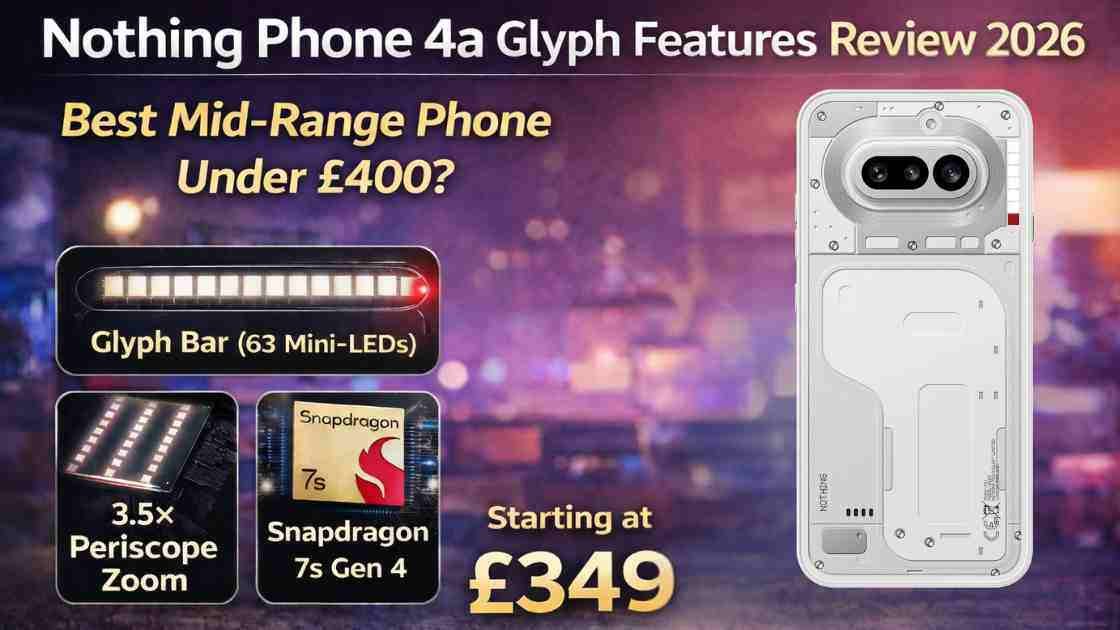
The result? A phone that confidently evolves its signature transparent aesthetic, introduces the redesigned Glyph Bar as the centrepiece of the Nothing Phone 4a Glyph features system, ships Android 16 out of the box with Nothing OS 4.1, and packs a 3.5x periscope telephoto camera – a rare feature for this price segment. Starting at £349 / €349 / approximately $349 USD, the Nothing Phone 4a enters one of the most competitive segments in the market. If you are exploring alternatives in this price range, our guide to the Best Budget Smartphones Under £400 in 2025 compares the top devices competing in this category.
This comprehensive review covers every angle: from the revamped Nothing Phone 4a Glyph features and Glyph Bar LED system to the performance of the Snapdragon 7s Gen 4 chip, camera quality, software experience with Nothing OS 4.1, battery life, and a direct comparison with the Pixel 10a. Let’s dive in.
Quick Verdict
| Our Rating: 8.2 / 10The Nothing Phone 4a is the most distinctive mid-range phone of 2026. The Glyph Bar is cleverly engineered, the display is brilliant, and Nothing OS 4.1 delivers a clean, fast experience. Camera quality is capable but not class-leading. The main trade-offs are the absence of NFC and wireless charging – but at this price, the overall package is outstanding. |
Full Specifications at a Glance
| Specification | Details |
| Display | 6.78-inch Flexible AMOLED, 1.5K resolution, 120Hz refresh rate, 1,600 nits peak brightness |
| Processor | Qualcomm Snapdragon 7s Gen 4 |
| RAM / Storage | 8GB RAM + 128GB | 12GB RAM + 256GB |
| Rear Camera 1 | 50MP Samsung GN9 primary sensor with OIS (64% more light capture) |
| Rear Camera 2 | 50MP Samsung JN5 Tetraprism Periscope Telephoto, 3.5x optical / 7x lossless / 70x ultra zoom |
| Rear Camera 3 | 8MP Sony Ultra-Wide, 119.5° field of view |
| Front Camera | 32MP selfie camera |
| Battery | 5,080mAh (largest ever in Nothing A-series) |
| Charging | 50W wired fast charging (no wireless charging) |
| OS | Android 16 with Nothing OS 4.1 out of the box |
| Glyph System | Glyph Bar: 63 mini-LEDs in 7 squares, 3,500 nits peak brightness |
| Build | Transparent back panel, plastic frame, Corning Gorilla Glass 7i (front) |
| Durability | IP64 rated, 34% improved bend resistance vs Phone (3a) |
| Dimensions | 204.5g weight, 8.6mm thickness |
| Colours | White, Black, Blue, Pink |
| Price | From £349 / €349 / ~₹31,999 INR |
| Availability | March 13, 2026 (global retail) |
Nothing Phone 4a Glyph Features: The Glyph Bar Explained
The Nothing Phone 4a Glyph features are, without question, the most talked-about element of this phone. And this year, the entire system has been reimagined. Gone is the familiar Glyph Interface – the scattered arrangement of LEDs that first appeared on the Nothing Phone (1) in 2022. In its place sits the all-new Glyph Bar: a linear, rectangular strip of 63 mini-LEDs organized into seven distinct square segments running horizontally across the upper section of the phone’s transparent back panel.
Glyph Bar: Hardware Specifications
The Glyph Bar is a significant engineering undertaking for a phone at this price. Here are the key hardware facts:
- 63 mini-LED rectangles arranged in 7 equal square clusters
- Peak brightness of 3,500 nits – up to 40% brighter than the Phone (3a)’s Glyph Lights
- Includes a dedicated red recording indicator LED (borrowed from Nothing’s flagship Phone 3)
- Linear bar format replaces the scattered circular Glyph arrangement from previous generations
- Visible from across a room, even in bright ambient light
What Can the Glyph Bar Do?
The Nothing Phone 4a Glyph features go well beyond simple notification flashing. Here is what the Glyph Bar is capable of in 2026:
- Incoming Call Notifications: Each contact can be assigned a unique Glyph pattern, so you can identify who’s calling without looking at the screen.
- App Notifications: Designated apps can trigger custom Glyph patterns, allowing you to distinguish between messaging apps, email, and social media at a glance.
- Battery Charging Indicator: The Glyph Bar fills progressively from left to right as the phone charges, giving you an instant battery level readout.
- Timer & Countdown Visualization: The Glyph Bar drains from right to left as a visual countdown timer – genuinely useful for cooking, workouts, or productivity sprints.
- Music Visualizer: The segments pulse and animate in time with music, a fun if somewhat niche feature.
- Volume Indicator: The bar displays current volume level during media playback.
- Recording Indicator: The red LED activates whenever the camera or microphone is recording, a privacy transparency feature lifted from the flagship Phone 3.
Live Notifications: The Glyph Bar’s Most Forward-Looking Feature
The most significant new addition to the Nothing Phone 4a Glyph features is Live Notifications, which builds on Android 16’s native Live Updates API. When paired with supported apps like Uber, Google Maps, Zomato, Just Eat, and Google Calendar, the Glyph Bar displays a real-time progress bar. This means you can see a delivery approaching, a ride arriving, or a meeting countdown – all without touching your phone.
In practice, the feature works as described, though supported app availability is limited at launch. Nothing has confirmed more app integrations are in the pipeline. The concept is compelling: the Glyph Bar becomes a glanceable activity indicator rather than a passive notification light, reducing screen-on time and digital distraction – a philosophy Nothing calls ‘reducing the noise.’
Glyph Bar vs. Previous Glyph Interface: Is It Better?
The shift from the scattered Glyph Interface to the linear Glyph Bar is a deliberate simplification. The previous system spread LEDs across multiple zones on the back panel, offering a higher visual density. The Glyph Bar condenses that into a single horizontal strip. The result is more understated and cleaner – it integrates more naturally with the transparent design – but it does sacrifice some of the expressive range of the previous generation. Whether that’s a downgrade depends entirely on how creatively you used the old system.
One clear win: the 3,500 nits peak brightness makes the Glyph Bar far more visible than its predecessor, particularly in outdoor or bright indoor environments. Notifications are genuinely easier to spot from a distance.
Design & Build Quality: A Transparent Identity
The Nothing Phone 4a continues the brand’s commitment to transparent design. he trend toward transparent smartphone aesthetics has also appeared in viral concepts like the Nokia transparent phone, though Nothing remains the only major manufacturer currently shipping such designs at scale.
The rear casing exposes the structural geometry of the device – battery outlines, antenna lines, and the camera module housing are all visible through the frosted-clear back panel. This year, the design feels more refined and deliberate. The horizontal camera bar from 2024’s Phone (2a) has been preserved, but the module has migrated upward, now framed by a pill-shaped aluminium track element that references a running oval.
Available in White, Black, Blue, and Pink, the Phone 4a is a visual standout in every colourway. The white model, with its red Glyph Bar and red accent details, is particularly striking. The phone sits flat on a table due to the flush camera module, a practical design detail that makes it easier to use without picking up.
Build quality is solid for the price point. The Corning Gorilla Glass 7i on the front provides reliable scratch and drop protection, and Nothing claims 34% improved bend resistance over the Phone (3a). The IP64 rating offers protection against dust and water splashes, though it falls short of the IP68 certification found on the Pixel 10a. At 204.5g and 8.6mm thickness, the phone has a premium-adjacent heft without feeling unwieldy.
Display: Bright, Sharp, and Beautifully Calibrated
The 6.78-inch Flexible AMOLED display is a genuine highlight. The 1.5K resolution (1080 x 2392 pixels) delivers 440 PPI – crisp enough that individual pixels are invisible at normal viewing distances. The 120Hz refresh rate keeps scrolling and animations smooth, and the variable refresh rate dynamically adjusts to save battery during static content. If high-refresh displays are important to you, you may also want to explore our guide to the Best Budget Smartphones Under £400 with 120Hz Display, where several competing devices in this price segment are compared.
Peak brightness reaches 1,600 nits in HDR mode, which is competitive for this class. Outdoor legibility is excellent on a sunny day, a common weak point for mid-range displays. Colours are vivid without being oversaturated, and the AMOLED panel delivers deep blacks that make the always-on display and Glyph Bar notifications feel integrated rather than jarring against the surrounding darkness.
Compared to the Pixel 10a’s 6.29-inch pOLED panel at 120Hz, the Nothing Phone 4a offers a noticeably larger canvas – a meaningful advantage for media consumption, gaming, and productivity tasks. The Phone 4a’s display is one of the best in its price range in 2026.
Nothing OS 4.1 Features: Clean, Smart, and Distinctively Nothing
The Nothing Phone 4a ships with Android 16 and Nothing OS 4.1 out of the box. This is the software experience that differentiates Nothing from every other Android manufacturer in the mid-range segment, and it remains one of the most compelling reasons to buy the phone.
Core Nothing OS 4.1 Features
- Dot Matrix Font & Monochrome UI: Nothing’s signature typography and visual language, delivering a cohesive, retro-tech aesthetic across the entire interface.
- Essential Space: A dedicated side-panel hub for AI-powered tools, widgets, and shortcuts. Access it by pressing the Essential Key on the right edge.
- Essential Search: A system-wide intelligent search that reaches across apps, files, contacts, and the web simultaneously.
- Essential Apps: Build custom lightweight apps directly on the home screen using AI, without requiring any coding knowledge.
- Nothing X Integration: Deep integration with Nothing’s growing ecosystem of earbuds, watches, and accessories.
- Glyph Composer: A dedicated interface for creating and customizing Glyph Bar patterns for contacts, apps, and timers.
- Bloatware-Free: No pre-installed carrier apps, no sponsored shortcuts, no aggressive upsells.
Android 16 Under the Hood
Android 16 brings several meaningful improvements that Nothing OS 4.1 builds upon. Live Updates – the system API that powers the Glyph Bar’s Live Notifications – is a core Android 16 feature. Improved predictive back gestures make navigating the interface feel more responsive. Battery optimizations extend screen-on time, and enhanced privacy controls give users more granular control over sensor access and app permissions.
Nothing promises 3 years of Android OS updates and 6 years of security patches for the Phone 4a. This is notably shorter than Google’s 7-year commitment on the Pixel 10a, which is an important consideration for buyers planning to hold the phone for more than three years.
| Software VerdictNothing OS 4.1 is arguably the most distinctive Android skin on the market in 2026. It prioritizes user experience, aesthetic consistency, and AI utility without bloat. The Essential Space features are genuinely useful, and the Glyph Composer makes the Glyph Bar personalizable rather than just functional. The 3-year update window is the only meaningful weakness. |
Camera System: Ambition Meets Mid-Range Reality
The Nothing Phone 4a’s camera system is its most ambitious hardware upgrade in the series’ history. The inclusion of a periscope telephoto lens at this price point is remarkable – it was unthinkable in the mid-range segment as recently as 2023. Periscope zoom systems were previously limited to flagship phones such as the Samsung Galaxy S25 Ultra, which introduced advanced long-range zoom to the mainstream smartphone market.
Main Camera: 50MP Samsung GN9
The primary sensor uses the Samsung GN9 – a 1/1.95-inch sensor that Nothing claims captures 64% more light than competing sensors of similar class. OIS (Optical Image Stabilization) keeps handheld shots sharp, and the TrueLens Engine 4.0 processes images with a focus on natural colour reproduction rather than aggressive AI sharpening.
In bright daylight, the main camera produces detailed, well-exposed images with accurate (if slightly cool) colour rendering. Dynamic range is good, and HDR processing handles high-contrast scenes competently. Low-light performance is above average for the segment, with Night Mode producing usable shots in challenging conditions, though some noise creeps into deep shadow areas.
Periscope Telephoto: 50MP Samsung JN5
This is the headline camera feature. The tetraprism periscope design allows 3.5x optical zoom, 7x lossless zoom, and up to 70x ultra zoom without the bulging camera module that traditional telephoto lenses require. At 3.5x, image quality is sharp and detailed – portrait shots in particular benefit enormously from this focal length, producing natural subject separation and compressed backgrounds.
Beyond 7x, digital interpolation takes over and quality degrades progressively, as is standard across the industry. The 70x ultra zoom is best treated as a novelty rather than a practical tool. Still, having 3.5x optical and 7x lossless zoom in a sub-£400 phone is a genuine achievement.
Ultra-Wide: 8MP Sony
The 8MP ultra-wide is the weakest link in the camera system. At 119.5 degrees field of view, it captures expansive scenes effectively, but the lower resolution sensor shows its limitations in low light, producing softer results with visible noise. Colour consistency between the main and ultra-wide sensors also varies slightly, a common challenge in multi-camera systems.
Creative Camera Features
- LUTs & Presets: Apply cinematic colour grades in real-time while shooting – a feature unique to Nothing in this class.
- Custom Presets: Save your own contrast, vignette, and colour adjustments as reusable presets.
- Motion Photos: Captures a short video clip before each still shot.
- Night Mode & Portrait Mode: Standard but competently implemented.
- 4K Video at 30fps and 1080p at 60fps: Adequate for social media and everyday use.
| Camera VerdictThe Nothing Phone 4a’s camera system is excellent for the price, led by the impressive periscope telephoto lens. The main sensor is capable in good light. Where it falls short of the Pixel 10a is in Google’s AI-powered computational photography: Night Sight, Magic Eraser, and Tensor-optimized video processing remain in a different league. But for pure hardware versatility under £400, the Phone 4a wins handily. |
Performance: Smooth Daily Use, Gaming-Ready
The Snapdragon 7s Gen 4 is an upper-tier mid-range processor that handles everything most users throw at it with ease. App launches are fast, multitasking between a dozen open apps is seamless, and the UI scrolls at a consistent 120fps. Nothing has also implemented a custom CPU scheduler in Nothing OS 4.1 that prioritizes foreground tasks and smooths frame timing in demanding applications.
Nothing claims the Phone 4a can sustain 120FPS in titles like BGMI (Battlegrounds Mobile India) and 90FPS in Call of Duty: Mobile. In day-to-day use, the phone does not stutter, lag, or throttle under normal workloads – web browsing, social media, streaming, navigation, and productivity apps all run without friction.
Benchmark performance sits below flagship-grade processors (unsurprisingly) but comfortably above the previous-generation Snapdragon 695 found in budget mid-range competition. The 12GB RAM variant is recommended for users who frequently multitask or use RAM-intensive apps.
Battery Life: All-Day Power with Fast Wired Charging
The 5,080mAh battery is the largest Nothing has ever fitted into an A-series phone. In real-world use, it comfortably delivers a full day of mixed usage – social media, streaming, photography, navigation, and productivity – with charge to spare by bedtime. Heavy users pushing gaming and extended video streaming can reasonably expect to run the battery low by late evening.
50W wired fast charging fills the battery from zero to approximately 50% in around 30 minutes and reaches a full charge in approximately 65-70 minutes. This is fast, though not the fastest in the segment. The absence of wireless charging is a notable omission at this price point – the Pixel 10a supports wireless charging, which many users find more convenient for overnight top-ups.
Nothing Phone 4a vs Google Pixel 10a: Head-to-Head Comparison
The Google Pixel 10a is the most direct competitor to the Nothing Phone 4a in 2026. Both target the £349-£499 mid-range segment, both run Android 16, and both offer distinctive software experiences. Here is how they compare across every key dimension:
| Feature | Nothing Phone 4a | Google Pixel 10a |
| Display Size | 6.78-inch AMOLED | 6.29-inch pOLED |
| Display Brightness | 1,600 nits peak | 3,000 nits peak |
| Refresh Rate | 120Hz variable | 120Hz |
| Processor | Snapdragon 7s Gen 4 | Tensor G4 (flagship-grade) |
| Main Camera | 50MP Samsung GN9 + OIS | 48MP main sensor |
| Telephoto Camera | 50MP, 3.5x optical periscope | 13MP ultrawide only |
| Ultra-Wide | 8MP, 119.5° | 13MP |
| Battery | 5,080mAh | 5,100mAh |
| Wired Charging | 50W | 18W |
| Wireless Charging | None | Yes (7.5W) |
| Water Resistance | IP64 | IP68 |
| OS Updates | 3 years Android | 7 years Android |
| Security Updates | 6 years | 7 years |
| Unique Feature | Glyph Bar, transparent design | Tensor AI, Google ecosystem |
| Starting Price | £349 / ~$349 | £499 / $499 |
| NFC | No | Yes |
When to Choose the Nothing Phone 4a
- You want the most unique design in the mid-range segment
- The Glyph Bar notification system appeals to your workflow
- Camera versatility (3.5x optical telephoto) matters more than computational photography
- You prefer a larger display for media consumption
- Budget is a key consideration – the Phone 4a starts ~£150 cheaper than the Pixel 10a
- You want clean Android without Google ecosystem lock-in
When to Choose the Google Pixel 10a
- Google’s AI photography (Magic Eraser, Night Sight, Best Take) is important to you
- Long-term software support (7 years) is a priority
- You rely on NFC for contactless payments
- Wireless charging is essential for your daily routine
- IP68 water resistance matters (e.g., frequent outdoor or poolside use)
- You are already invested in the Google/Android ecosystem
Pros and Cons
| Feature | Nothing Phone 4a | Google Pixel 10a |
| Design | ✅ Most unique design in class | ❌ No wireless charging |
| Display | ✅ Large, bright AMOLED panel | ❌ IP64, not IP68 |
| Glyph Bar | ✅ Genuinely useful notifications | ❌ No NFC support |
| Camera | ✅ Rare 3.5x periscope telephoto | ❌ Weak ultra-wide camera |
| Software | ✅ Clean, fast Nothing OS 4.1 | ❌ Only 3 years OS updates |
| Battery | ✅ Large 5,080mAh, 50W charging | ❌ Selfie camera disappoints |
| Price | ✅ Excellent value at £349 | ❌ Slightly heavier at 204.5g |
Frequently Asked Questions (FAQs)
1. What are the Nothing Phone 4a Glyph features in 2026?
The Nothing Phone 4a Glyph features centre on the new Glyph Bar: a linear strip of 63 mini-LEDs (in 7 square clusters) on the rear panel. It supports customizable notification patterns for calls and apps, battery level display, countdown timers, music visualizer, volume indicator, a privacy recording indicator LED, and Live Notifications via Android 16’s Live Updates API for real-time activity tracking with supported apps like Uber and Google Maps.
2. How does Nothing OS 4.1 differ from stock Android 16?
Nothing OS 4.1 adds a distinct visual identity (Dot Matrix font, monochrome UI elements), Essential Space (an AI tool hub), Essential Search, Essential Apps builder, Glyph Composer for Glyph Bar customization, and deep Nothing ecosystem integration. It removes bloatware and third-party pre-installs found on many Android skins. The underlying Android 16 security and privacy features are preserved intact.
3. Does the Nothing Phone 4a have NFC?
No. The Nothing Phone 4a does not include NFC for contactless payments. This is a notable omission for users who rely on Google Pay, Apple Pay alternatives, or transport card emulation. If NFC is essential, the Google Pixel 10a or the Nothing Phone (4a) Pro are better-suited alternatives.
4. How does the Nothing Phone 4a camera compare to the Pixel 10a?
The Nothing Phone 4a has superior hardware versatility, with a 50MP main sensor and a 3.5x optical periscope telephoto camera that the Pixel 10a lacks. However, Google’s computational photography – powered by the Tensor G4 chip – produces more consistently excellent results, particularly in low light, portraits, and video. The Pixel 10a wins on image processing; the Phone 4a wins on zoom range and hardware specification.
5. What is the Nothing Phone 4a battery life like?
The 5,080mAh battery comfortably lasts a full day of mixed use – browsing, social media, camera use, and navigation. Heavy users (gaming, extended video streaming) may see battery levels below 20% by late evening. The 50W wired fast charging delivers approximately 50% charge in 30 minutes. There is no wireless charging.
6. Is the Nothing Phone 4a waterproof?
The Nothing Phone 4a carries an IP64 rating, meaning it is protected against dust ingress and water splashes from any direction. It is not submersion-rated. The Google Pixel 10a’s IP68 rating makes it more suitable for swimming or heavy rain. For most everyday use cases, IP64 provides adequate protection.
7. How long will the Nothing Phone 4a receive software updates?
Nothing has committed to 3 years of Android OS updates (taking the phone to Android 19) and 6 years of security patches. This is significantly shorter than the Pixel 10a’s 7-year Android update commitment, which extends to Android 23.
8. What is the price of the Nothing Phone 4a globally?
The Nothing Phone 4a starts at £349 / €349 in the UK and Europe. In India, pricing starts at ₹31,999. In the United States, the base Phone 4a is primarily available through the Nothing website, with US pricing approximately aligned with the European pricing at around $349. Pre-orders opened March 5, 2026, with retail availability from March 13, 2026.
Final Verdict: Should You Buy the Nothing Phone 4a?
| Overall Score: 8.2 / 10A bold, confident mid-range smartphone with the most distinctive design and Glyph notification system in its class. The Glyph Bar genuinely enhances everyday use. Nothing OS 4.1 is clean and smart. The periscope telephoto camera is a genuine differentiator at this price. Meaningful trade-offs include no NFC, no wireless charging, and a shorter update commitment than the Pixel 10a – but at £349, the value proposition is hard to argue with. |
The Nothing Phone 4a is the right choice for buyers who want a smartphone that reflects a distinct personality, prioritize camera hardware versatility and display size, and value a clean, bloat-free Android experience. It is a phone for people who understand that specifications alone do not make a great phone – design philosophy, software experience, and distinctive features matter just as much.
For buyers who rely on NFC, demand the best possible camera processing, or want the longest possible software update window, the Google Pixel 10a remains the more pragmatic choice.
But in 2026’s crowded mid-range market, the Nothing Phone 4a is the only phone you will not forget the moment you put it down. And in a sea of sameness, that counts for a great deal.
Academic & Industry References
- TechRadar (2026). “Nothing Phone (4a) review: a budget phone that stands out from the crowd.”
- Tech Advisor (2026). “Nothing Phone (4a) Review: Transparent Temptation.”
- Mark Ellis Reviews (2026). “Nothing Phone (4a) Review: This Is Getting Tough.”