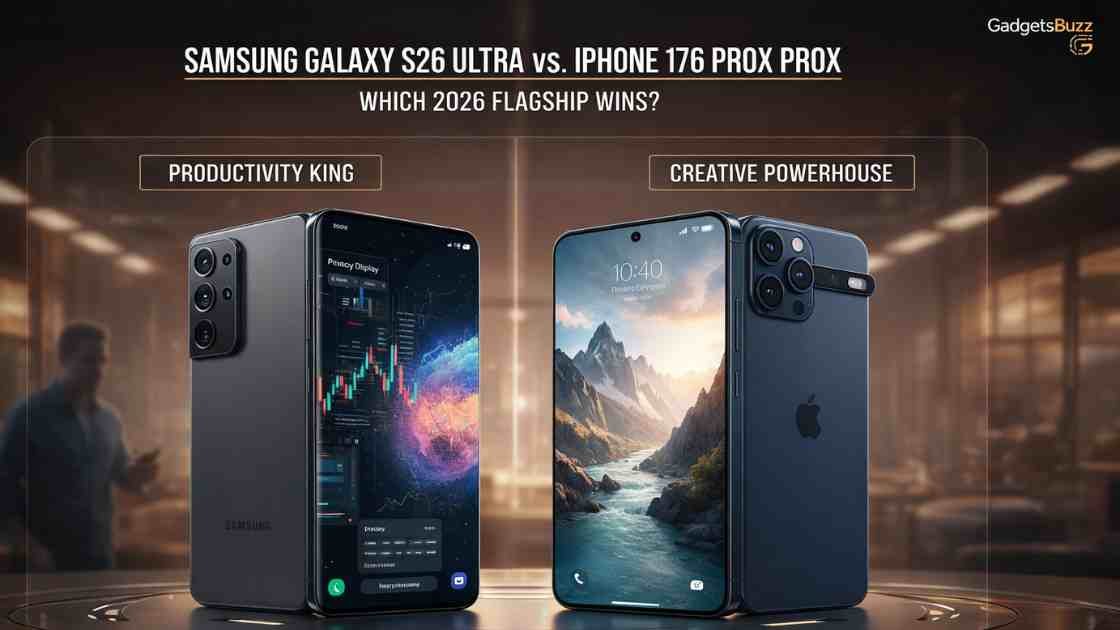
The highly anticipated 2026 flagship confrontation, pitting the Samsung Galaxy S26 Ultra vs iPhone 17 Pro Max, marks a pivotal moment in the evolution of premium mobile technology, where cutting-edge innovation meets refined user experience. This comprehensive technical analysis delves into the nuanced advancements of these two titans, dissecting their architectural prowess, photographic capabilities, intelligent ecosystems, and power efficiencies.
As both manufacturers push the boundaries of what a smartphone can achieve, discerning the superior device necessitates an in-depth examination of their respective strengths and strategic innovations, moving beyond mere specification sheets to uncover the true impact on the discerning prosumer.
The battle for 2026’s smartphone supremacy is not merely about incremental upgrades; it represents a convergence of sophisticated hardware and deeply integrated artificial intelligence, tailored to empower users in unprecedented ways. From revolutionary display technologies that prioritize digital privacy to silicon architectures boasting unprecedented computational fluidity, and camera systems redefining mobile imaging, the Galaxy S26 Ultra and iPhone 17 Pro Max stand as epitomes of current technological zenith. This article provides a rigorous, data-driven comparison, offering crucial insights for professionals and enthusiasts navigating the pinnacle of smartphone engineering.
Quick Comparison Table: Samsung Galaxy S26 Ultra vs. iPhone 17 Pro Max
For a preliminary overview, the following table summarizes key specifications and distinguishing features of the Samsung Galaxy S26 Ultra and the iPhone 17 Pro Max, offering a snapshot of their competitive positioning.
| Feature | Samsung Galaxy S26 Ultra | iPhone 17 Pro Max |
|---|---|---|
| Display Technology | Hardware-based Privacy Display (AI-controlled viewing angles) | 3,000 Nits Peak Brightness, Ceramic Shield 2 |
| Chipset | Snapdragon 8 Elite Gen 5 (Custom) | A19 Pro |
| Geekbench 6 Multi-core (Leaked) | 11,738 | 9,831 |
| Thermal Management | Advanced Vapor Chamber Cooling | Advanced Vapor Chamber Cooling, Aluminum/Glass Hybrid Back |
| Rear Camera System | 200MP Quad-System (200MP Main, 50MP 5x Telephoto, 100x Space Zoom, Nightography Video) | Triple 48MP Setup (Main, Ultra-Wide, Telephoto; consistent color grading, 4K 120fps ProRes video) |
| AI Features | Galaxy AI 2026 (“Now Nudges,” context-aware, Google Gemini & Perplexity integration) | Apple Intelligence (local-first AI, Siri deep app integration, “Dual Capture” AI video) |
| Wired Charging Speed | 60W (75% in 30 mins) | 40W |
| Video Playback Battery Life | (Estimated lower than iPhone) | 39 hours (Apple’s efficiency) |
| Profile Thickness | 7.9mm | (Standard Apple Flagship) |
| Rear Camera Design | (Vertically aligned/minimal protrusion) | Horizontal Camera Bar |
The Design Shakeup: Samsung’s Sleek Profile vs. Apple’s Robust Aesthetics
In the realm of flagship smartphone design, both Samsung and Apple continue to refine their aesthetic and ergonomic principles, albeit with divergent philosophies. The Samsung Galaxy S26 Ultra emerges with a notably slimmer 7.9mm profile, signifying a persistent industry trend towards minimizing device thickness without compromising structural integrity or component integration. This slender form factor is often achieved through advanced internal component miniaturization and optimized battery packaging, contributing to a more comfortable in-hand feel and a sleek visual appeal.
As noted by Noreen Fahad in our Samsung Galaxy S25 Ultra Review (2025): AI, Camera & Performance, that device marked a “bold leap” by shedding the sharp, boxy corners of the past for a more ergonomic feel. The S26 Ultra doubles down on this comfort, proving that Samsung has finally moved away from the Note-like rigidity of previous years.
Conversely, the iPhone 17 Pro Max maintains Apple’s established design language, albeit with a distinct evolution in its rear camera housing, featuring a horizontal camera bar. This design choice, while potentially impacting the device’s visual symmetry for some, is engineered to accommodate the advanced triple 48MP sensor array and associated optical stabilization mechanisms, ensuring optimal photographic performance.
Apple’s commitment to durability is further underscored by the continued integration of a robust frame, rumored to be an aluminum/glass hybrid, which enhances both heat dissipation and overall resilience. This material innovation is critical for sustained performance under heavy workloads, particularly for mobile gaming and intensive video processing. The industry also notes a general return to flat displays, favored for their durability and reduced accidental touches, a design principle Apple has consistently adhered to.
Durability remains a paramount concern for premium smartphones. While Samsung aims for a sleek form, Apple reinforces its devices with advancements like Ceramic Shield 2. This next-generation protective layer offers significantly enhanced resistance to scratches and micro-damage, building upon its predecessor’s reputation for exceptional drop performance. The meticulous engineering behind these design choices reflects each brand’s interpretation of premium device aesthetics and functional endurance for the demanding user of 2026.
The Innovation Round: Privacy Display vs. 3,000 Nits Brightness
The display technologies on the Samsung Galaxy S26 Ultra and the iPhone 17 Pro Max represent two distinct yet equally significant frontiers in smartphone innovation: digital privacy and outdoor visibility, respectively. Each approach addresses a critical user need in an increasingly mobile and visually-driven world.
Samsung’s Innovation: The Hardware-based Privacy Display
The Samsung Galaxy S26 Ultra introduces a groundbreaking hardware-based Privacy Display, hailed as a world-first in consumer smartphones. This sophisticated technology employs AI-controlled viewing angles, meticulously engineered to “black out” the screen for anyone attempting to view it from the side, effectively preventing shoulder-surfing. Unlike conventional software filters or adhesive screen protectors that merely dim the display or compromise color fidelity, Samsung’s solution integrates anti-snooping technology directly into the Flex Magic Pixel OLED panel itself.
This pixel-level modulation ensures that the primary user experiences crystal-clear visuals and vibrant colors, while peripheral observers encounter a darkened or obscured image. The system can be manually activated or configured to engage automatically, for instance, when accessing sensitive applications like banking platforms or messaging apps, or even in response to the detection of an observer by the device’s AI. This innovation is a direct response to the escalating demand for enhanced personal data security in public environments, transforming privacy from a software toggle into a fundamental hardware attribute.
Apple’s Edge: 3,000 Nits Peak Brightness and Ceramic Shield 2
In contrast, the iPhone 17 Pro Max solidifies Apple’s dominance in display luminance and structural durability. Boasting an astounding 3,000 nits peak brightness, the device sets a new benchmark for outdoor visibility, ensuring content remains perfectly legible even under direct sunlight or in brightly lit environments. This level of brightness is not only crucial for practical outdoor use but also significantly enhances the viewing experience for HDR content, where dynamic range and contrast are paramount.
Complementing this visual brilliance is the introduction of Ceramic Shield 2, a further refinement of Apple’s proprietary cover glass technology. Engineered with an advanced nano-crystal matrix, Ceramic Shield 2 provides up to three times more scratch resistance than its predecessor, in addition to superior drop performance. This material innovation represents a paradigm shift from traditional glass protection, offering unprecedented hardness levels through atomic-level bonding processes. While Samsung champions privacy, Apple remains the unparalleled leader in delivering displays that are both exquisitely bright and remarkably resistant to the rigors of daily wear and tear.
Performance & AI: Who is Actually Faster? Snapdragon 8 Elite Gen 5 vs. A19 Pro

The computational cores of flagship smartphones are the engine of their capabilities, and in 2026, the battle between Qualcomm’s Snapdragon 8 Elite Gen 5 and Apple’s A19 Pro has taken an intriguing turn. For the first time, leaked Geekbench 6 multi-core scores suggest a performance shift, challenging Apple’s long-held lead in raw processing power.
While the official specs confirmed today at Unpacked align with the high expectations of the tech community, many of these breakthroughs were first hinted at in our earlier Samsung Galaxy S26 Ultra Leaks: A Comprehensive Technical Analysis, where we correctly predicted the shift to the Snapdragon 8 Elite Gen 5 architecture.
The Power Shift: Snapdragon 8 Elite Gen 5
The Samsung Galaxy S26 Ultra is powered by a custom variant of the Snapdragon 8 Elite Gen 5, engineered for unparalleled performance and efficiency. Recent leaked Geekbench 6 scores indicate a multi-core performance of 11,738, which, astonishingly, surpasses its direct competitor. This chipset is built on an advanced 3nm process technology and features a 3rd generation Oryon CPU architecture, typically comprising two high-performance prime cores and six efficiency cores, optimized for demanding multi-threaded applications and sustained workloads.
Qualcomm’s focus on heterogeneous computing and specialized accelerators for AI tasks further augments the SoC’s overall capability, ensuring seamless multitasking and robust performance across all applications, from intensive gaming to complex AI model execution.
Apple’s A19 Pro: Redefined Efficiency and Sustained Performance
The iPhone 17 Pro Max houses Apple’s latest silicon, the A19 Pro. While historically dominant in single-core performance, the A19 Pro has demonstrated a leaked Geekbench 6 multi-core score of 9,831. This chip is expected to leverage an even more advanced process, potentially a 2nm node, focusing on maximizing performance per watt and integrating sophisticated Neural Accelerators for on-device AI workloads.
Apple’s strategic emphasis often lies in optimizing the synergy between hardware and software (iOS), which translates into exceptional real-world responsiveness and efficiency, even if raw benchmark numbers don’t always reflect this entirely. The A19 Pro is designed to deliver not just peak performance, but highly sustained performance, crucial for professional users and mobile gamers.
Thermal Management: The Vapor Chamber Era
Both flagship devices incorporate advanced thermal management systems, signaling an industry-wide recognition that sustained performance is as crucial as peak power. The new Vapor Chamber cooling technology is present in both the S26 Ultra and the iPhone 17 Pro Max. This sophisticated heat dissipation mechanism is vital for maintaining optimal operating temperatures during extended periods of high computational load, thereby preventing thermal throttling and ensuring consistent performance.
A notable advantage for mobile gamers and power users on the iPhone 17 Pro Max is Apple’s transition to an aluminum/glass hybrid back. This material innovation is not merely aesthetic; it significantly enhances heat dissipation, allowing the A19 Pro chip to maintain its formidable performance levels for longer durations, a critical factor during prolonged gaming sessions or intensive video editing. Samsung’s commitment to thermal efficiency within its slimmer 7.9mm profile also necessitates advanced vapor chamber integration, ensuring the Snapdragon 8 Elite Gen 5 can operate at its peak without thermal compromise.
Camera: 200MP Quad-System vs. Triple 48MP Setup
In the perennial battle for smartphone camera supremacy, the Samsung Galaxy S26 Ultra and iPhone 17 Pro Max present two highly advanced, yet distinct, imaging philosophies for 2026. Samsung continues its pursuit of optical zoom and high-resolution versatility, while Apple refines its approach to color consistency and cinematic video capabilities.
The Evolution of a Rivalry: It is fascinating to see how far these imaging systems have come in just two years. Many of the AI-driven color science improvements we see today began with the foundational shifts documented in our classic comparison: Battle of Titans: iPhone 15 Pro Max vs. Samsung S24 Ultra.
Samsung’s Zoom: The 200MP Quad-System
The Samsung Galaxy S26 Ultra boasts a formidable 200MP Quad-System, building upon its legacy of photographic prowess. The centerpiece is its upgraded 200-megapixel main sensor, capable of capturing an astonishing level of detail, especially beneficial for intricate scenes and extensive cropping potential. Complementing this, the device features an upgraded 50MP 5x telephoto sensor, significantly enhancing optical zoom capabilities and delivering sharper, more detailed distant shots.
This system, in conjunction with Samsung’s renowned computational photography, facilitates an impressive 100x Space Zoom, allowing users to capture subjects at extreme distances with surprising clarity.
Further augmenting its video capabilities, Samsung has introduced a new “Nightography Video” algorithm, released today. This innovation leverages advanced AI processing and sensor fusion to dramatically improve video quality in low-light conditions, minimizing noise, enhancing detail, and maintaining accurate color reproduction, rivaling dedicated videography equipment in challenging environments.
This holistic quad-camera approach offers unparalleled versatility, from expansive ultra-wide shots to extreme telephoto captures, cementing Samsung’s position as a leader in flexible and powerful mobile photography.
Apple’s Consistency: The Triple 48MP Setup
The iPhone 17 Pro Max, true to Apple’s meticulous engineering, adopts a refined triple 48MP sensor setup, encompassing the Main, Ultra-Wide, and Telephoto lenses.
For a detailed breakdown of how this sensor array was engineered, see our previous coverage on the iPhone 17 Camera: Full Features, Specs & Upgrades Explained, which explores the transformational step Apple took in its mobile imaging architecture.
Apple’s strategy here emphasizes perfect color grading consistency across all three sensors. This means that regardless of which lens is used, the resulting images and videos exhibit identical color science, white balance, and tonal characteristics, which is a critical advantage for professional photographers and videographers who require seamless integration of footage from different perspectives.
A hallmark of Apple’s video capabilities, the iPhone 17 Pro Max further elevates its industry-leading 4K 120fps ProRes video recording. This professional-grade codec preserves an extraordinary amount of visual information, offering unparalleled flexibility in post-production for color grading, effects, and detailed editing.
The ability to record ProRes at such high frame rates, particularly when coupled with external storage solutions, positions the iPhone 17 Pro Max as an indispensable tool for filmmakers and content creators seeking cinematic quality from a mobile device. Apple’s focus remains on delivering a highly refined and consistent imaging experience, prioritizing professional-grade output and seamless creative workflows.
The “Agentic AI” Experience: Galaxy AI 2026 vs. Apple Intelligence
The year 2026 marks a profound paradigm shift in smartphone intelligence, moving beyond reactive voice assistants to proactive, context-aware “Agentic AI.” Both Samsung and Apple are at the forefront of this evolution, each charting a distinct course in integrating artificial intelligence into the core user experience.
Galaxy AI 2026: The Proactive Companion
Samsung’s Galaxy AI 2026, debuting with the S26 Ultra, is engineered to transform the smartphone into a truly proactive companion. Its flagship feature, “Now Nudges,” leverages sophisticated context-aware AI to predict the user’s next task or need, offering relevant information or actions before explicit commands are given. This deeper integration goes beyond simple automation; it involves the AI understanding user patterns, environmental cues, and application states to offer genuinely helpful interventions.
The Galaxy S26 Ultra benefits from deeper integration with leading AI models, specifically Google Gemini and Perplexity. Google Gemini provides expansive, multimodal comprehension and generation capabilities, while Perplexity acts as an advanced “answer engine,” delivering research-backed information and insights directly.
This collaborative AI ecosystem allows the S26 Ultra to act as a multipurpose agent, autonomously fetching information, executing complex workflows across applications, and providing intelligent assistance that significantly streamlines daily digital interactions.
Apple Intelligence: Local-First and Deeply Integrated
Apple’s approach to Agentic AI, termed “Apple Intelligence,” prioritizes a local-first processing philosophy. By executing complex AI models directly on the device, powered by the A19 Pro’s Neural Accelerators, Apple aims to ensure unparalleled privacy, security, and instantaneous responsiveness. This local processing minimizes reliance on cloud servers, addressing growing concerns about data privacy and latency in AI interactions.
Apple Intelligence deeply integrates with Siri, transforming the virtual assistant from a command-response interface into a more intuitive, contextually aware entity that can interact seamlessly across a user’s applications and data. This allows Siri to understand personal context and perform multi-step actions within the iOS ecosystem more efficiently and privately.
Furthermore, Apple introduces new “Dual Capture” AI video features, leveraging on-device AI for intelligent scene analysis, dynamic framing, and enhanced computational video processing, pushing the boundaries of what’s possible in mobile content creation through smart automation. Apple’s vision centers on making AI feel like an invisible, yet indispensable, part of the user’s daily life, empowering creative and personal productivity with an emphasis on security.
Battery and Charging Speed: The Endurance Race and the Charging Gap
Battery longevity and charging speeds remain critical differentiating factors in the flagship smartphone market, directly impacting user convenience and workflow continuity. In 2026, while both Samsung and Apple push for efficiency, a noticeable “charging gap” persists between the two giants.
The Charging Gap: Samsung’s Leap to 60W
A significant pain point for many users has historically been the relatively conservative charging speeds offered by major flagships. However, the Samsung Galaxy S26 Ultra finally addresses this by making a substantial leap to 60W wired charging. This advancement allows the device to reach approximately 75% charge in just 30 minutes, drastically reducing downtime and enhancing user mobility.
The USB-C 4.0 Advantage: Crucially, both the Galaxy S26 Ultra and the iPhone 17 Pro Max have fully transitioned to the USB-C 4.0 (USB4) standard. This ensures that Samsung’s new 60W peak is achievable using any high-quality, third-party Power Delivery (PD) 3.1 or USB4-compliant brick. For users already owning 100W+ laptop chargers, this baseline compatibility means “one cable to rule them all” has finally become a reality in 2026.
This move aligns Samsung more closely with the aggressive fast-charging strategies seen in the broader Android ecosystem, where many brands offer 80W or even 120W systems. The adoption of higher wattage charging solutions typically involves advanced battery chemistries, such as silicon-carbon (Si-C) cells, enabling denser energy storage without a significant increase in physical battery size.
In stark contrast, the iPhone 17 Pro Max, while showing improvements over its predecessors, is still positioned at a more modest 40W wired charging. While this is an improvement for Apple, it leaves a considerable gap compared to Samsung’s offering. Apple’s rationale often centers on preserving battery health over many charge cycles, prioritizing long-term degradation over peak charging speed.
Longevity: Apple’s Efficiency Edge
Despite the disparity in charging speeds, Apple often maintains an edge in real-world battery longevity due to its superior hardware-software optimization. The iPhone 17 Pro Max, despite potentially housing a physically smaller battery than some Android counterparts, is noted for its exceptional efficiency, resulting in impressive endurance, such as an estimated 39 hours of video playback.
This efficiency is largely attributed to the tightly integrated A19 Pro chip, which is meticulously optimized for low power consumption, particularly under varied workloads. Combined with iOS’s stringent background process management and adaptive refresh rate displays, Apple devices are renowned for extracting maximum usage hours from their battery capacities.
While the S26 Ultra boasts faster charging, Apple’s sustained operational time often means fewer overall charging cycles are needed throughout a demanding day, providing a different, but equally valuable, form of battery convenience. The debate here shifts from how fast a phone charges to how long it actually lasts on a single charge, where Apple consistently sets high benchmarks.
Final Verdict: The Productivity King vs. The Creative Powerhouse
The 2026 flagship landscape, dominated by the Samsung Galaxy S26 Ultra and the iPhone 17 Pro Max, illustrates a clear bifurcation in strategic emphasis, catering to distinct segments of the premium smartphone market. Each device represents a pinnacle of mobile engineering, yet their core value propositions diverge, defining them as either a “Productivity King” or a “Creative Powerhouse.”
The **Samsung Galaxy S26 Ultra** firmly establishes itself as “The Productivity King.” Its groundbreaking hardware-based Privacy Display is a testament to its commitment to discreet and secure functionality, indispensable for professionals handling sensitive information in public environments.
This, combined with the raw, leading multi-core processing power of its custom Snapdragon 8 Elite Gen 5 chip and the proactive, context-aware “Now Nudges” of Galaxy AI 2026—powered by deep integrations with Google Gemini and Perplexity—creates an ecosystem designed to anticipate and streamline professional workflows.
The significant leap to 60W wired charging further reinforces its utility for the on-the-go professional who demands rapid replenishment and minimal downtime. Its versatile 200MP Quad-System with advanced zoom and Nightography Video offers unparalleled flexibility for capturing diverse content, making it a comprehensive tool for dynamic professional requirements.
In contrast, the **iPhone 17 Pro Max** embodies “The Creative Powerhouse.” Its unparalleled 3,000 nits peak brightness and the indestructible Ceramic Shield 2 make its display an ideal canvas for visual artists and content creators who operate across varied lighting conditions and demand exceptional durability. The A19 Pro chip, while potentially ceding the multi-core benchmark lead, offers supreme sustained performance through its advanced vapor chamber cooling and aluminum/glass hybrid back, crucial for intensive creative tasks like 4K 120fps ProRes video editing.
Apple’s triple 48MP camera system, with its unwavering commitment to consistent color grading across all lenses, provides a reliable and cohesive platform for cinematic capture. Furthermore, Apple Intelligence, with its local-first processing and deep Siri integration, offers a private and seamlessly integrated AI experience that empowers creative ideation and execution, while “Dual Capture” AI video features enhance mobile storytelling.
Ultimately, the choice between the Samsung Galaxy S26 Ultra and the iPhone 17 Pro Max hinges on individual priorities. For the business executive, the privacy-conscious professional, or the power user who values unparalleled multitasking, intelligent workflow automation, and rapid charging, the Galaxy S26 Ultra offers an unmatched productivity suite.
For the professional photographer, videographer, graphic designer, or content creator who demands the absolute best in display quality, robust durability, consistent imaging, and a deeply integrated, secure AI environment for creative endeavors, the iPhone 17 Pro Max stands as the uncontested choice. Both devices represent the pinnacle of 2026 smartphone technology, each excelling in its carefully sculpted domain.
Frequently Asked Questions: S26 Ultra vs. iPhone 17 Pro Max
What is the key display innovation on the Samsung Galaxy S26 Ultra?
The Samsung Galaxy S26 Ultra features a world-first hardware-based Privacy Display. This technology uses AI-controlled viewing angles to ‘black out’ the screen for anyone looking from the side, preventing shoulder-surfing without compromising clarity for the primary user.
How bright is the iPhone 17 Pro Max display and how durable is it?
The iPhone 17 Pro Max boasts an impressive 3,000 nits peak brightness for superior outdoor visibility. It is also protected by Ceramic Shield 2, which offers significantly enhanced scratch resistance and durability compared to its predecessor.
Which phone has a faster processor based on leaked benchmarks?
Based on today’s leaked Geekbench 6 multi-core scores, the Samsung Galaxy S26 Ultra’s custom Snapdragon 8 Elite Gen 5 chip achieved 11,738 points, reportedly beating the iPhone 17 Pro Max’s A19 Pro chip, which scored 9,831.
What are the camera system differences between the two flagships?
The Samsung Galaxy S26 Ultra features a 200MP Quad-System with an upgraded 50MP 5x telephoto sensor and 100x Space Zoom, alongside a new ‘Nightography Video’ algorithm. The iPhone 17 Pro Max uses a Triple 48MP setup (Main, Ultra-Wide, Telephoto) for perfectly consistent color grading and industry-leading 4K 120fps ProRes video recording.
How do their AI experiences differ in 2026?
The Samsung Galaxy S26 Ultra introduces Galaxy AI 2026 with ‘Now Nudges,’ context-aware AI deeply integrated with Google Gemini and Perplexity for proactive task prediction. Apple Intelligence on the iPhone 17 Pro Max focuses on local-first AI processing for enhanced privacy, deep Siri app integration, and new ‘Dual Capture’ AI video features.
What are the charging speed capabilities of each phone?
The Samsung Galaxy S26 Ultra has significantly upgraded to 60W wired charging, capable of reaching 75% in 30 minutes. In contrast, the iPhone 17 Pro Max still charges at a maximum of 40W wired.
Which phone offers better real-world battery longevity?
Despite potentially having a smaller battery capacity, the iPhone 17 Pro Max is expected to offer superior real-world battery longevity, with an estimated 39 hours of video playback, largely due to Apple’s highly optimized hardware and software efficiency.
Further Reading & Official Resources
- Samsung Newsroom: Samsung Unveils Galaxy S26 Series: The Most Intuitive Galaxy AI Phone Yet Direct from the source: Detailed breakdown of the S26 Ultra’s Privacy Display, 60W Super Fast Charging 3.0, and the new APV professional video codec.
- Qualcomm Official Brief: Snapdragon 8 Elite Gen 5: The Era of Agentic AI and Mobile Video PowerTechnical specifications for the chipset powering the S26 Ultra, including the 37% NPU speed boost and Unreal Engine 5 mesh shading support.
- Apple Insider Comparison: iPhone 17 Pro Max vs. Samsung Galaxy S26 Ultra: The 2026 Tale of the TapeA deep dive into the specific hardware differences, including the iPhone’s 3,000 nits display benchmarks and Apple’s 48MP triple-lens consistency.